


Blog
How universities are transforming faculty engagement with AI-powered outreach
June 29, 2026
•
xx
MIN READ
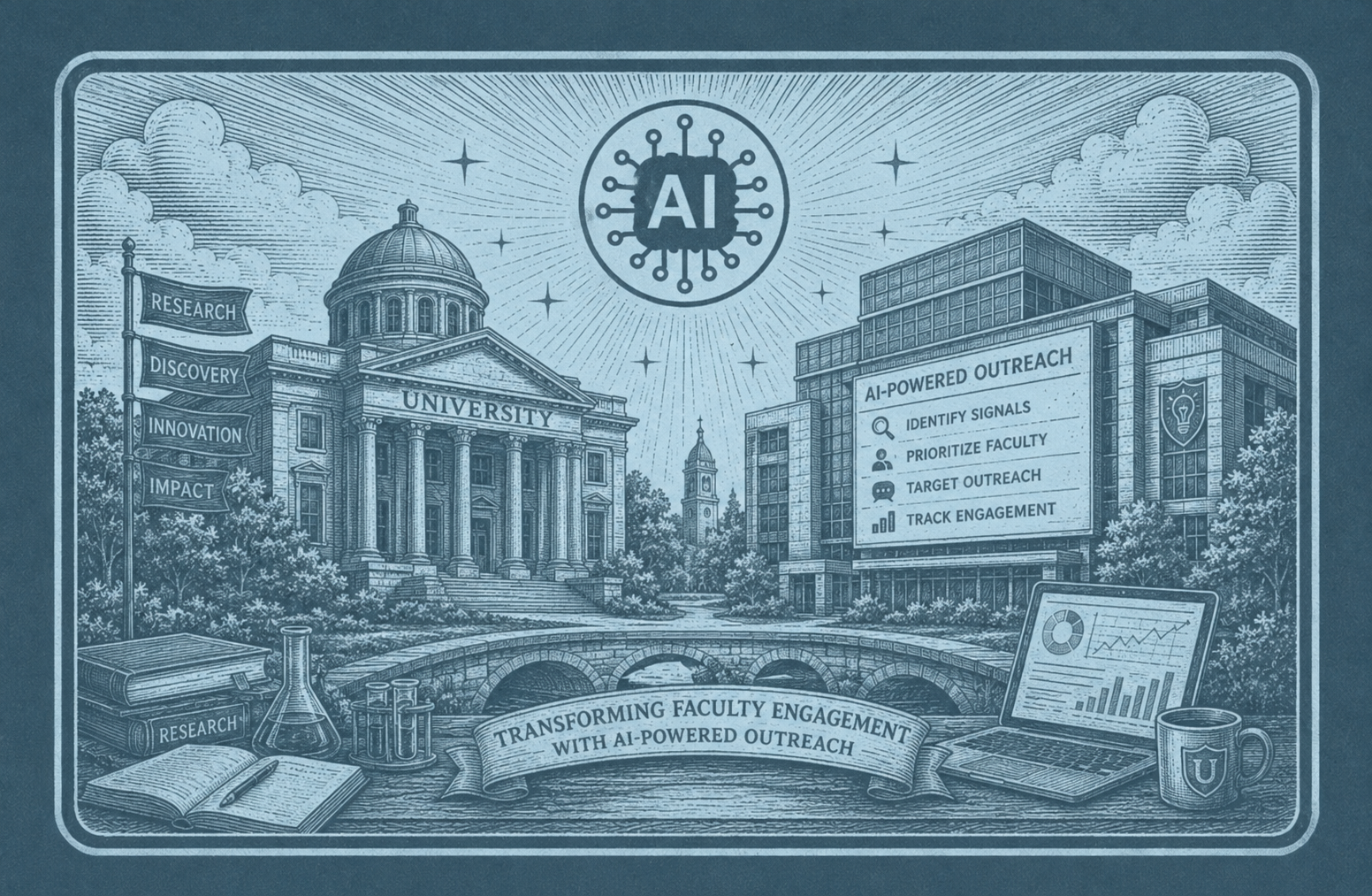
Table of contents
Faculty IP does not begin in a CRM. It begins in everyday research. A lab experiment, a grant milestone, a student conversation. But between discovery and disclosure, there is a gap that most technology transfer offices still struggle to close.
When faculty do not recognize what qualifies as protectable IP or do not know who to tell, valuable inventions never make it into the commercialization pipeline. When that happens, universities lose not just licensing revenue but also the chance to translate research into real-world impact.
Across institutions, a consistent pattern is emerging. Teams are moving from passive disclosure models to proactive faculty engagement strategies.
From inbound disclosure to proactive discovery
Traditionally, most tech transfer offices rely on a simple model. Educate faculty, wait for disclosures, then evaluate IP.
But this model assumes two things that often are not true.
First, that faculty understand what counts as an invention.
Second, that they know when and how to engage the TTO.
In practice, promising innovations are often invisible to the office until long after key decisions have been made such as publication, external collaboration, or early commercialization activity.
As a result, many TTO teams describe a similar challenge. They are onlyseeing the tip of the iceberg.
The shift to a faculty engagement engine
Rather than treating engagement as a communications function, leading institutions are redefining it as an operational workflow.
The goal is shifting from faculty coming to the office when ready to identifying and engaging faculty earlier in the research lifecycle.
To do that, teams are focusing on a few core capabilities:
- Identifying research signals earlier
- Prioritizing faculty and projects with commercialization potential
- Coordinating outreach across departments
- Tracking engagement over time in a structured way
This is where platforms like FirstIgnite are being used to supportfaculty engagement workflows at scale.
Turning research signals into actionable outreach
The core challenge is not a lack of information. It is fragmentation.
Research activity lives across publications, grants, internal systems,and personal networks. Without a unified view, it becomes difficult to know who to engage and when.
AI-supported engagement systems help teams consolidate these signals and surface:
- Emerging research themes across departments
- Faculty working in IP-relevant domains
- Potential industry alignment opportunities
- Signals that indicate early stage innovation activity
This allows outreach to shift from reactive to timely.
Instead of engaging after a discovery is fully formed, teams can begin conversations earlier when guidance, education, and support are most effective.
A new model of faculty outreach
As engagement becomes more data informed, outreach is changing.
Instead of broad, generalized messaging, institutions are moving toward targeted, context aware communication such as:
- Your recent work in X area may have commercialization relevance, here is how disclosure works
- We are seeing strong industry interest in Y, your research may align
- Here is how similar research at peer institutions moved toward licensing
The tone becomes less administrative and more collaborative.
Because outreach is grounded in actual research activity, engagement quality improves.
Scaling what was once relationship driven
Historically, faculty engagement depended heavily on individual TTO staff knowledge, such as who was working on what, who might disclose, and who needed follow up.
That model can work at small scale but becomes difficult as research volume increases.
Modern engagement workflows aim to systematize that institutional knowledge by:
- Centralizing faculty and research activity data
- Tracking engagement history in one place
- Coordinating outreach across teams
- Reducing reliance on individual memory or siloed spreadsheets
The goal is not to replace human relationships but to make them more scalable and consistent.
Why this matters now
Universities are under increasing pressure to translate research into measurable impact faster and with fewer resources.
At the same time, research output continues to grow across disciplines,making it harder for TTOs to keep pace using traditional outreach methods.
The gap between what is being discovered and what is being disclosed is widening.
Proactive faculty engagement is becoming one of the few levers that directly addresses that gap.
Conclusion: engagement is becoming infrastructure
Faculty engagement is shifting from an informal outreach activity to acore operational system within innovation offices.
The institutions making progress are not just improving communications.They are building structured ways to identify, prioritize, and engage potential inventors earlier.
FirstIgnite’s faculty engagement capabilities are designed to support that shift, helping teams bring more visibility to research activity and more consistency to outreach.
Because IP does not start at disclosure.
It starts when institutions are able to see and act on research signals early enough to matter.
Related resources
FirstIgnite delivers AI-powered prospecting, agentic outreach, and partnership data management—giving impact-driven organizations everything they need to grow meaningful partnerships.