


RESOURCES
Blogs
Insights, strategies, and updates on research commercialization, university innovation, industry partnerships, and AI-powered prospecting
Connecting Industry & Academia
CMU and Fujitsu Launch Physical AI Research Center
April 27, 2026
•
xx
MIN READ
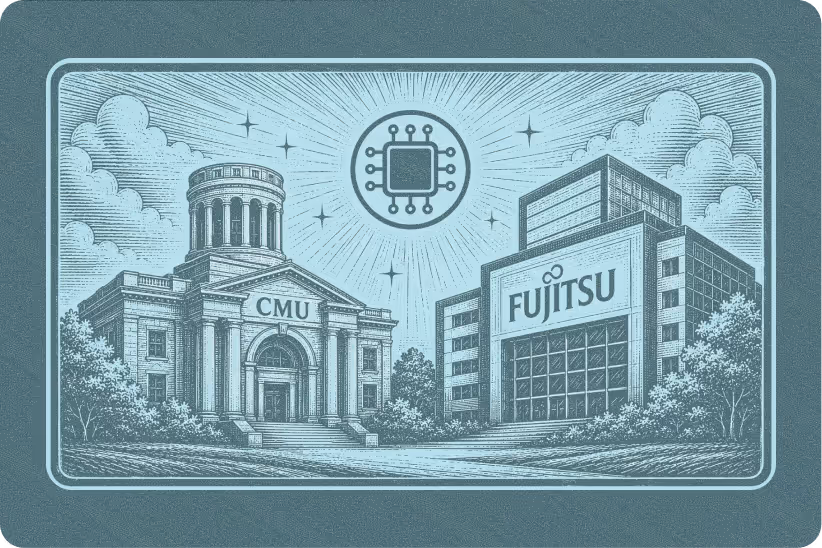
Artificial intelligence is moving beyond servers and screens. Carnegie Mellon University (CMU) and Fujitsu, a top Japanese IT provider, have partnered on an AI research center to revolutionize how machines interact with the physical world.
The Fujitsu-Carnegie Mellon Physical AI Research Center is devoted to creating AI-powered machines and robots that tackle critical issues like labor shortages and workplace safety. This groundbreaking partnership is a major leap toward bringing innovative physical AI solutions to real-world challenges.
This partnership demonstrates how embedding intelligence into real-world machines—and working together—drives true innovation across industries.
Bringing AI into the Physical World
Physical AI puts intelligence directly into robots and autonomous systems, allowing them to act, interact, and make decisions in the real world instead of just processing data behind screens.
With physical AI, machines can sense, decide, and act in real environments—handling obstacles and delicate tasks while making decisions on the spot. They move beyond computation to direct participation in the world.
Interest in physical AI is rapidly growing as experts turn to robotics and machine learning for practical solutions. The Fujitsu-CMU Center is the hub where these ideas become real-world innovations.
A State-of-the-Art Testing Ground
The research center is based at CMU’s advanced Robotics Innovation Center in Pittsburgh, offering top facilities for developing and testing physical AI systems.
The 150,000-square-foot facility equips researchers to rigorously develop and test physical AI systems, ensuring these machines are safe, reliable, and ready for real-world impact.
Solving the Global Labor Crisis
Global labor shortages are putting pressure on industries everywhere. Physical AI offers a real solution by enabling robots to handle repetitive or dangerous tasks, increasing productivity and safety while allowing people to focus on higher-value work.
Physical AI enables companies to boost productivity by deploying robots for repetitive or hazardous tasks, improving efficiency and workplace safety.
Physical AI empowers workers by handling tough, repetitive tasks. This lets people focus on safer, strategic roles and boosts overall efficiency.
Transforming Manufacturing and Logistics
Physical AI boosts manufacturing and logistics by helping robots quickly handle complex tasks like navigating warehouses, assembling parts, and managing inventory. This leads to faster, more reliable deliveries and efficient operations.
Unlike traditional robots, AI-powered machines quickly adapt to unexpected obstacles and changing environments.
These smart systems streamline tasks like loading, assembly, and inventory, making supply chains faster and more reliable.
Advancing Construction, Infrastructure, and Healthcare
Physical AI is revolutionizing construction, infrastructure, and healthcare by empowering robots to handle complex tasks, enhance safety, and support staff in critical roles.
In construction and infrastructure, robots handle heavy lifting, precise tasks, and structural inspections, improving safety and speeding up projects while preventing failures.
Physical AI also addresses healthcare staffing shortages by helping with patient transport, room cleaning, and supply management, allowing medical professionals to focus more on patient care.
The Power of Academic and Industry Partnerships
The Fujitsu-Carnegie Mellon Physical AI Research Center proves that major breakthroughs happen through strong academic and industry partnerships—achieving what neither could do alone.
Fujitsu brings deep IT expertise, while CMU leads in robotics, engineering, and AI research.
By combining CMU’s research innovation with Fujitsu’s industry know-how, this partnership rapidly turns groundbreaking AI and robotics ideas into real-world solutions that deliver real value.
Breaking Down Disciplinary Silos
Effective physical AI requires cross-disciplinary teamwork, combining expertise in engineering, robotics, language technologies, and ethics to tackle complex challenges.
Center experts in robotics, engineering, language technology, and ethics collaborate closely to ensure every physical AI system is advanced, safe, and reliable.
Why Collaboration and Standardization Matter
Physical AI still faces hurdles, like supply chain gaps and lack of standardization that keep robots and systems disconnected.
Without common standards and collaboration, physical AI systems stay isolated and can't scale across industries. The Fujitsu-CMU partnership is crucial for connecting these systems and enabling widespread adoption.
The Fujitsu-CMU partnership is driving physical AI forward by establishing standards and encouraging collaboration, making it easier for businesses to adopt and integrate smart machines across industries.
Building on a Legacy of AI Innovation
CMU advances AI by partnering with industry leaders to drive innovative research and real-world impact.
CMU’s recent collaboration with Bank of New York Mellon created a major AI Lab, while the university’s Learnvia platform now supports AI-driven learning at colleges nationwide.
Martial Hebert, dean of CMU’s School of Computer Science, says the new center strengthens CMU’s commitment to solving real-world problems through industry partnerships, ensuring innovations reach those who need them most.
Partner with FirstIgnite to Build the Future
The Fujitsu-Carnegie Mellon Physical AI Research Center proves that real progress comes from strong partnerships between industry and leading universities.
Partnering with leading institutions unlocks innovative AI and robotics solutions for your toughest business challenges.
Let FirstIgnite connect you with top academic partners to drive innovation and strategic growth.
Contact FirstIgnite to explore partnerships and accelerate innovation for your business.

.avif)
University
August 4, 2023
•
xx
MIN READ
FirstIgnite is supporting the commercialization of Florida International University’s new bacterial inhibitors for antibacterial drug development technology, involving the synthesis of antibacterial compounds, which inhibits bacterial topoisomerase I, an enzyme essential for the viability of many pathogens. These compounds exhibit bactericidal properties, holding potential for infection treatment and antibacterial drug development against many pathogens.
This innovative technology offers a unique mechanism of action distinct from existing antibiotics. It addresses the urgent need for treatments against multi-drug resistant bacterial pathogens. It's versatile for parenteral injection, oral administration, and rectal use, with enhanced solubility compared to previous compounds. The antibiotic resistance market is worth $8.68 billion as of 2023 and is expected to reach $12.7 billion by 2030.
Florida International University’s bacterial inhibitors for antibacterial drug development technology is ready for collaboration (licensing, partnerships, industry feedback, etc.). Is your company the right fit? If you’d be available for a conversation with the Florida International University team, you can schedule a time directly on their team’s calendar here.
University
Collaborate: Predictive Biomarkers for Organ Damage
August 4, 2023
•
xx
MIN READ
FirstIgnite is supporting the commercialization of Florida International University’s new predictive biomarkers technology, which is able to detect organ damage in autoimmune illnesses. This technology also enables tailored treatments to prevent, reduce, or halt organ involvement, without invasive blood procedures.
This technology predicts and diagnoses lung and kidney issues in autoimmune patients, enabling proactive screening, potential expansion to other organ diseases, and post-transplant success monitoring. The global biomarkers market size was worth $39.10 billion in 2018 and is projected to reach $97.51 billion by 2026.
Florida International University’s predictive biomarkers technology is ready for collaboration (licensing, partnerships, industry feedback, etc.). Is your company the right fit? If you’d be available for a conversation with the Florida International University team, you can schedule a time directly on their team’s calendar here.
University
Collaborate: Fully Homomorphic Encryption
August 4, 2023
•
xx
MIN READ
FirstIgnite is supporting the commercialization of Johns Hopkins University Applied Physics Laboratory's new fully homomorphic encryption (FHE) technology, which enables data processing that does not compromise privacy, even in the face of capable and determined cyber adversaries. This form of encryption allows for computation and seamless querying of encrypted data while safeguarding the underlying information.
This technology applies to finance, government privacy protection, cloud management, data analytics, and healthcare, enabling predictive insights while protecting sensitive information. The global data privacy software market size is valued at $2.76 billion in 2023 and is expected to increase to $30.31 billion by 2030.
Johns Hopkins University Applied Physics Laboratory’s FHE technology is ready for collaboration (licensing, partnerships, industry feedback, etc.). Is your company the right fit? If you’d be available for a conversation with the Johns Hopkins team, you can schedule a time directly on their team’s calendar here.
University
Collaborate: RADSoM: Reusable Space-Grade Hardware
August 4, 2023
•
xx
MIN READ
FirstIgnite is supporting the commercialization of Johns Hopkins University Applied Physics Laboratory’s new RADSoM technology, which is an innovative approach to space-grade hardware reuse that can significantly reduce design time as well as the cost and risk of increasingly complex board and box designs. RADSoM is the only system on a module in its class designed for the space environment, enabling rapid product development, repairs, and upgrades.
This technology has a wide variety of space applications, including spaceborne computers, radios, modems, instrument processors, and interface electronics. The global space electronics market was valued at $3.3 billion in 2021 and is projected to reach $5.4 billion by 2031.
Johns Hopkins University Applied Physics Laboratory’s RADSoM technology is ready for collaboration (licensing, partnerships, industry feedback, etc.). Is your company the right fit? If you’d be available for a conversation with the Johns Hopkins University APL team, you can schedule a time directly on their team’s calendar here.
Blogs
FirstIgnite
How Self-Healing Materials Companies Can Use FirstIgnite For Success
August 3, 2023
•
xx
MIN READ
FirstIgnite is an artificial intelligence software which allows self-healing materials organizations to quickly identify companies and contacts specifically interested in their services and to perform in-depth competitor and market analysis.
Quickly Identifying New Customers
It’s important for self-healing materials companies to identify potential customers not because of an assumption that the customer has market fit, but rather on concrete reasons why these customers would benefit from a self-healing materials product or service. FirstIgnite’s AI-driven platform can profile customers quickly, providing self-healing materials companies with access to precise contact details and comprehensive insights into their roles and responsibilities. This enhances customer acquisition, satisfaction, and loyalty by catering to precise needs while enabling targeted outreach to potential customers seeking specific services.
Conducting a Comprehensive Competitive Analysis
FirstIgnite also enables self-healing materials companies in identifying potential competitors based on their own services. No matter the particular project a team is engaged in, they can rely on FirstIgnite to deliver comprehensive analyses of competitive organizations and an overview of the marketplace as a whole. With FirstIgnite, your organization can pinpoint untapped revenue streams, thereby uncovering new opportunities for growth.
The FirstIgnite software is available for license. Please reach out to our team to inquire about getting a free demo scheduled today!
Blogs
FirstIgnite
How Advanced Material Companies Can Use FirstIgnite For Success
August 3, 2023
•
xx
MIN READ
FirstIgnite is an artificial intelligence software which allows advanced materials organizations to quickly identify companies and contacts specifically interested in their services and to perform in-depth competitor and market analysis.
Quickly Identifying New Customers
It’s important for advanced materials companies to identify potential customers not because of an assumption that the customer has market fit, but because there is a literal reason why a customer would benefit from an advanced material product. FirstIgnite offers powerful customer profiling capabilities, enabling advanced material companies to identify and target potential customers specifically seeking a certain service. This not only increases the chances of acquiring new customers but also enhances customer satisfaction and loyalty by providing them with precisely what they need.
Conducting a Comprehensive Competitive Analysis
FirstIgnite also enables advanced materials companies in identifying potential competitors based on their own services. Whatever specific initiative an advanced materials team is working on, they can trust FirstIgnite to provide analysis of competitive organizations and an overview of the marketplace as a whole. There are new revenue streams ready to be identified with FirstIgnite.
The FirstIgnite software is available for license. Please reach out to our team to inquire about getting a free demo scheduled today!
Blogs
FirstIgnite: Leveraging Artificial Intelligence for Sales and Business Development Growth
August 2, 2023
•
xx
MIN READ
Like most corporate teams, sales and business development offices are adapting to the advent of artificial intelligence. These disruptors are bringing important changes to industries all over the world, no more so than the increasing productivity of several business functions.
In this regard, FirstIgnite provides an artificial intelligence software that allows sales, strategy, and business development staff to identify companies and contacts specifically in need of your company’s services and products, because those same services and products will have a beneficial impact on their bottom line. FirstIgnite users are also able to engage in in-depth market and competitive analysis, building an understanding of what challenges are occurring today and which are just beyond the horizon.
By incorporating FirstIgnite into a sales team’s tech package, companies can ensure that their proactive outbound communication will quickly uncover thousands of new potential customers.
Quickly Identify Companies and Contacts Interested In Your Products and Services

Can you really know a customer better than they know themselves? With FirstIgnite, the answer is yes! The FirstIgnite software provides specific reasons why each particular company is appearing and matching to your input. Are they seeking to purchase your products because of a new internal initiative? Maybe your services will provide them with a new strategic advantage. FirstIgnite is analyzing millions of data points to provide you with the warmest leads possible.
Identify New Market Applications

Scientific organizations can leverage FirstIgnite to identify additional market applications for their various products, enabling the growth of new business opportunities. Our AI leverages information on your product, including patents and other scientific literature, in order to identify market opportunities where this type of science can be used.
Create Powerful Real-Time Market and Competitive Analysis

New competitors don’t announce when they are ready to swipe at your market share. With FirstIgnite, you can quickly assess which organizations are profiting in your space and why, comparing your current initiatives with those of organizations all over the world. Being proactive in understanding your market is the difference between growth and decline. FirstIgnite ensures that your company stays within that growth mindset.
Artificial intelligence is providing new business for you today! Get ahead of your new customers and competitors and schedule a demo with FirstIgnite here.
University
Collaborate: Methods for Data Compression
August 1, 2023
•
xx
MIN READ
FirstIgnite is supporting the commercialization of Florida International University’s new methods for data compression technology, which involves an algorithm for compressing data to reduce index size. This technology delivers reduced search memory footprint, faster peptide inference speed, and lower memory consumption compared to traditional computational methods.
This technology is applicable to compressing data generated from mass spectrometry, the analysis of complex protein mixtures in biomedical research, and has potential applications in fields requiring efficient data compression and handling of large databases. The global data compression market was valued at $3.01 billion in 2020 and is projected to increase to $4.51 billion by 2026.
Florida International University’s methods for data compression technology are ready for collaboration (licensing, partnerships, industry feedback, etc.). Is your company the right fit? If you’d be available for a conversation with the Florida International University team, you can schedule a time directly on their team’s calendar here.
University
Collaborate: Manufacturing Glass Scintillators
July 31, 2023
•
xx
MIN READ
FirstIgnite is supporting the commercialization of Florida International University’s new manufacturing glass scintillators using stereolithography technology, which are an alternative method of fabricating doped glass scintillators. This technology has many advantages, including reduced need for additional reducing agents or environments, enhanced stability of dopant in its luminescent oxidation state, and improved homogeneity of the dopant through stereolithography.
This technology is applicable to the detection of ionizing radiation, the electrical power industry as spectral converters for solar cells, and medical imaging devices for diagnostics. The global radiation detection, monitoring, and safety market size was worth $3 billion in 2021 and is projected to reach $5 billion by 2030.
Florida International University’s manufacturing glass scintillators technology is ready for collaboration (licensing, partnerships, industry feedback, etc.). Is your company the right fit? If you’d be available for a conversation with the Florida International University team, you can schedule a time directly on their team’s calendar here.
University
Collaborate: Center of Excellence in Wireless and Information Technology
July 21, 2023
•
xx
MIN READ
Stony Brook University’s Center of Excellence in Wireless and Information Technology (CEWIT) has partnered with FirstIgnite to connect with companies seeking collaborative support. This partnership offers a range of benefits, including industry collaboration, project sponsorship, field testing, access to workshops, commercialization support, and opportunities for internship programs and community outreach to cultivate the next generation of workforce.
CEWIT excels in conducting interdisciplinary research and development in wireless and information technology. The Center specializes in wireless and information technology solutions for industries including healthcare, defense and security, and sustainability.
The Stony Brook team is seeking industry collaboration. If your company is interested in exploring a partnership, you can schedule a conversation with the Stony Brook University team directly through their team’s calendar here.
University
Collaborate: Shortwave Infrared Imaging System
July 21, 2023
•
xx
MIN READ
FirstIgnite is supporting the commercialization of Johns Hopkins University Applied Physics Laboratory’s shortwave infrared imaging system technology. This technology utilizes a fiber optic bundle, distal lens, illumination assembly, and imaging detector to focus shortwave infrared wavelengths, enabling imaging in challenging environments like the human body and inaccessible machinery areas.
This technology has several applications including in the medical field, industrial sectors requiring inspection of confined spaces in machinery, and infrastructure management. The medical imaging market size is projected to be worth $48.8 billion by 2032, up from $29.2 billion in 2022.
Johns Hopkins University Applied Physics Laboratory’s shortwave infrared imaging system technology is ready for collaboration (licensing, partnerships, industry feedback, etc.). Is your company the right fit? If you’d be available for a conversation with the Johns Hopkins University APL team, you can schedule a time directly on their team’s calendar here.
University
Collaborate: Enhancing Machine to Machine Trust
July 20, 2023
•
xx
MIN READ
FirstIgnite is supporting the commercialization of Johns Hopkins University Applied Physics Laboratory’s enhancing machine to machine trust technology. This technology is a continuous, adaptive, lightweight trust computation framework designed for machine-to-machine (M2M) networks, leveraging distributed ledger and smart-contract technologies as its backbone.
This technology has various applications, including autonomous vehicles, smart city systems, smart energy grid control, M2M communications solutions, zero-trust security, and IoT devices. The M2M connections market was valued at $19.18 billion in 2020 and is projected to increase to $26.52 billion by 2026.
Johns Hopkins University Applied Physics Laboratory’s enhancing machine to machine trust technology is ready for collaboration (licensing, partnerships, industry feedback, etc.). Is your company the right fit? If you’d be available for a conversation with the Johns Hopkins University APL team, you can schedule a time directly on their team’s calendar here.