


RESOURCES
Blogs
Insights, strategies, and updates on research commercialization, university innovation, industry partnerships, and AI-powered prospecting
Connecting Industry & Academia
CMU and Fujitsu Launch Physical AI Research Center
April 27, 2026
•
xx
MIN READ
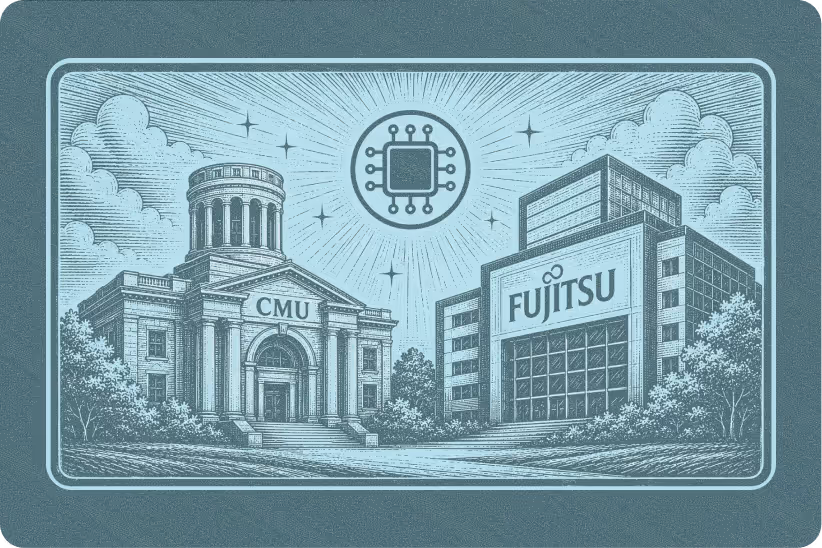
Artificial intelligence is moving beyond servers and screens. Carnegie Mellon University (CMU) and Fujitsu, a top Japanese IT provider, have partnered on an AI research center to revolutionize how machines interact with the physical world.
The Fujitsu-Carnegie Mellon Physical AI Research Center is devoted to creating AI-powered machines and robots that tackle critical issues like labor shortages and workplace safety. This groundbreaking partnership is a major leap toward bringing innovative physical AI solutions to real-world challenges.
This partnership demonstrates how embedding intelligence into real-world machines—and working together—drives true innovation across industries.
Bringing AI into the Physical World
Physical AI puts intelligence directly into robots and autonomous systems, allowing them to act, interact, and make decisions in the real world instead of just processing data behind screens.
With physical AI, machines can sense, decide, and act in real environments—handling obstacles and delicate tasks while making decisions on the spot. They move beyond computation to direct participation in the world.
Interest in physical AI is rapidly growing as experts turn to robotics and machine learning for practical solutions. The Fujitsu-CMU Center is the hub where these ideas become real-world innovations.
A State-of-the-Art Testing Ground
The research center is based at CMU’s advanced Robotics Innovation Center in Pittsburgh, offering top facilities for developing and testing physical AI systems.
The 150,000-square-foot facility equips researchers to rigorously develop and test physical AI systems, ensuring these machines are safe, reliable, and ready for real-world impact.
Solving the Global Labor Crisis
Global labor shortages are putting pressure on industries everywhere. Physical AI offers a real solution by enabling robots to handle repetitive or dangerous tasks, increasing productivity and safety while allowing people to focus on higher-value work.
Physical AI enables companies to boost productivity by deploying robots for repetitive or hazardous tasks, improving efficiency and workplace safety.
Physical AI empowers workers by handling tough, repetitive tasks. This lets people focus on safer, strategic roles and boosts overall efficiency.
Transforming Manufacturing and Logistics
Physical AI boosts manufacturing and logistics by helping robots quickly handle complex tasks like navigating warehouses, assembling parts, and managing inventory. This leads to faster, more reliable deliveries and efficient operations.
Unlike traditional robots, AI-powered machines quickly adapt to unexpected obstacles and changing environments.
These smart systems streamline tasks like loading, assembly, and inventory, making supply chains faster and more reliable.
Advancing Construction, Infrastructure, and Healthcare
Physical AI is revolutionizing construction, infrastructure, and healthcare by empowering robots to handle complex tasks, enhance safety, and support staff in critical roles.
In construction and infrastructure, robots handle heavy lifting, precise tasks, and structural inspections, improving safety and speeding up projects while preventing failures.
Physical AI also addresses healthcare staffing shortages by helping with patient transport, room cleaning, and supply management, allowing medical professionals to focus more on patient care.
The Power of Academic and Industry Partnerships
The Fujitsu-Carnegie Mellon Physical AI Research Center proves that major breakthroughs happen through strong academic and industry partnerships—achieving what neither could do alone.
Fujitsu brings deep IT expertise, while CMU leads in robotics, engineering, and AI research.
By combining CMU’s research innovation with Fujitsu’s industry know-how, this partnership rapidly turns groundbreaking AI and robotics ideas into real-world solutions that deliver real value.
Breaking Down Disciplinary Silos
Effective physical AI requires cross-disciplinary teamwork, combining expertise in engineering, robotics, language technologies, and ethics to tackle complex challenges.
Center experts in robotics, engineering, language technology, and ethics collaborate closely to ensure every physical AI system is advanced, safe, and reliable.
Why Collaboration and Standardization Matter
Physical AI still faces hurdles, like supply chain gaps and lack of standardization that keep robots and systems disconnected.
Without common standards and collaboration, physical AI systems stay isolated and can't scale across industries. The Fujitsu-CMU partnership is crucial for connecting these systems and enabling widespread adoption.
The Fujitsu-CMU partnership is driving physical AI forward by establishing standards and encouraging collaboration, making it easier for businesses to adopt and integrate smart machines across industries.
Building on a Legacy of AI Innovation
CMU advances AI by partnering with industry leaders to drive innovative research and real-world impact.
CMU’s recent collaboration with Bank of New York Mellon created a major AI Lab, while the university’s Learnvia platform now supports AI-driven learning at colleges nationwide.
Martial Hebert, dean of CMU’s School of Computer Science, says the new center strengthens CMU’s commitment to solving real-world problems through industry partnerships, ensuring innovations reach those who need them most.
Partner with FirstIgnite to Build the Future
The Fujitsu-Carnegie Mellon Physical AI Research Center proves that real progress comes from strong partnerships between industry and leading universities.
Partnering with leading institutions unlocks innovative AI and robotics solutions for your toughest business challenges.
Let FirstIgnite connect you with top academic partners to drive innovation and strategic growth.
Contact FirstIgnite to explore partnerships and accelerate innovation for your business.

.avif)
University
February 1, 2023
•
xx
MIN READ
FirstIgnite is supporting the commercialization of Worcester Polytechnic Institute’s new blood gas analyzer technology - the Luminescence Oxygen Sensor (LUO). This cost-efficient, miniaturized device can wirelessly and continuously monitor oxygen parameters for patients with fragile respiratory status, allowing for at-home management. The LUO's advantage is that it measures PtcO2 as rapidly as oxygen saturation, making PtcO2 data readily available through wireless communication for prompt clinical decision-making.
This technology is beneficial for patients with conditions such as high-risk newborns, asthma, COPD, sleep disorders, Covid-19, and other respiratory illnesses. In 2022, the market for blood gas and electrolyte analyzers was valued at $2.98 billion and is expected to increase to $3.75 billion by 2026.
Worcester Polytechnic Institute’s blood gas analyzer technology is ready for collaboration (licensing, partnerships, industry feedback, etc.). Is your company the right fit? If you’d be available for a conversation with the Worcester Polytechnic Institute team, you can schedule a time directly on their team’s calendar here.
University
Collaborate: Hydrophobic Paper
February 1, 2023
•
xx
MIN READ
FirstIgnite is supporting the commercialization of Mississippi State University’s hydrophobic paper technology. This technology uses a metal-ion modification method to convert conventional paper (e.g., newspapers, copy paper, packing paper, tissue paper, and kraft paper) to hydrophobic paper. This opens up new opportunities for use as packaging materials and tableware, as well as an absorbent for oil spill cleanup and a membrane for separating water and oil mixtures/emulsions.
This invention has the potential to revolutionize conventional paper products and tableware industries by making them water-repellent. As of 2023, the global paper products market is valued at $1036.59 billion and is projected to grow to $1293.15 billion by 2027.
Mississippi State University’s hydrophobic paper technology is ready for collaboration (licensing, partnerships, industry feedback, etc.). Is your company the right fit? If you’d be available for a conversation with the Mississippi State University team, you can schedule a time directly on their team’s calendar here.
University
Collaborate: Wind Load Reduction
February 1, 2023
•
xx
MIN READ
FirstIgnite is supporting the commercialization of Florida International University’s perforations on asphalt shingles for wind load reduction technology. Perforations in the leading edge of roofing asphalt shingles allow pressure reduction in the shingle’s cavity by directing flow upward through the gaps, reducing positive pressure inside the cavity. The technology offers improved aerodynamics, stronger wind resistance, and a streamlined manufacturing process.
The application of this technology to asphalt shingles for roofing holds great potential. The global roofing materials market was $23.88 billion in 2021 and is expected to reach $32.63 billion by 2030.
Florida International University’s wind load reduction technology is ready for collaboration (licensing, partnerships, industry feedback, etc.). Is your company the right fit? If you’d be available for a conversation with the Florida International University team, you can schedule a time directly on their team’s calendar here.
University
Collaborate: Modular Power Converter
February 1, 2023
•
xx
MIN READ
FirstIgnite is supporting the commercialization of Portland State University’s new modular power converter technology. The power converter concept provides power electronics designers with new tools for creating circuit designs with improved reliability, efficiency, and smaller volume through the use of fewer or smaller capacitors and modulated load-to-output controllers. Furthermore, this technology provides several benefits, including the ability to reduce the total capacitance required, use more reliable film capacitors with longer life and reliability compared to other formats, and a scalable architecture that suggests future designs may be more densely packed within the same volume.
Applications for this technology include power transmission, high voltage/current in minimal volume (transportation, personal electronics, lighting), photovoltaic charge capture, military, satellite, and space applications, LED arrays, and DC/DC and AC/DC conversion at higher efficiency. In 2022, the global electric power transmission and distribution market was valued at $209.65 billion and is anticipated to reach $326.5 billion by 2030.
Portland State University’s modular power converter is ready for collaboration (licensing, partnerships, industry feedback, etc.). Is your company the right fit? If you’d be available for a conversation with the Portland State University team, you can schedule a time directly on their team’s calendar here.
University
Collaborate: Communication Virtual Machine
February 1, 2023
•
xx
MIN READ
FirstIgnite is supporting the commercialization of Florida International University’s new Communication Virtual Machine (CVM) technology. This is a software technology that enables the creation, synthesis, and delivery of digital communication solutions across application domains. The CVM offers a model-based method for developing custom communication applications that meet the requirements of users. Its benefits include cost-effective and time-efficient communication, fast development, ease of use, reusability, reliability, support for both synchronous and asynchronous communication modes, network and device independence, and easy deployment over the internet.
The CVM is applicable to mainly telemedicine but also to industries like disaster management, defense communication, and banking & financing. In 2022, the telemedicine market was valued at $91.2 billion, and it is expected to reach $380.3 billion by 2030.
Florida International University’s CVM technology is ready for collaboration (licensing, partnerships, industry feedback, etc.). Is your company the right fit? If you’d be available for a conversation with the Florida International University team, you can schedule a time directly on their team’s calendar here.
Groundbreaking University Innovations
When University Innovation Changed the World: Polio Vaccine
January 30, 2023
•
xx
MIN READ
Did you know that a medical researcher at the University of Pittsburgh developed the polio vaccine? Dr. Jonas Salk originated the treatment that has saved millions of lives.
Polio is a viral illness, affecting children primarily, that impacts the nervous system, leading to muscle weakness and paralysis, particularly in the legs. Prior to the development of the polio vaccine, the disease killed many people and left others paralyzed. A total of 57,628 polio cases were reported in the United States in 1952. In the pursuit of an effective solution, Dr. Jonas Salk and his team at the University of Pittsburgh worked to develop a polio vaccine. In 1953, Dr. Salk tested the vaccine on himself and his family before conducting trials. The trials proved successful, and the vaccine was approved for widespread use in 1955, leading to a significant decrease in the incidence of polio.

Dr. Salk's polio vaccine has had a significant impact on public health, saving an estimated 1.5 million children's lives. Over the years, other researchers have continued to build on and refine the vaccine. As a result, there have been no cases of wild polio originating in the United States since 1979. With the growing global population, the demand for the polio vaccine has increased. In 2020, the market was valued at $13.95 billion and is projected to reach $20.29 billion by 2027.
Innovation at universities can change the world. By keeping track of the latest advancements, you can uncover new technologies that can give you a significant competitive advantage. FirstIgnite can help your organization identify and partner with the specific universities, laboratories, and experts you need in order to discover the next medical advancement, like the polio vaccine.
New Horizons
New Horizons: Digital Health
January 30, 2023
•
xx
MIN READ
Digital health refers to technologies related to computing platforms, connectivity, software, and sensors used for health care and related purposes. The global market for digital health was valued at $270.60 billion in 2021 and is predicted to reach $1354.68 billion by 2030. This market is growing rapidly due to the adoption of software solutions by patients, hospitals, healthcare providers, and insurance payers.
Companies play a significant role in delivering digital health services, including eHealth, cloud computing, and big data. Currently, the top digital health companies include Cisco ($51.6 billion dollar revenue as of 2021), Koninklijke Philips ($20.4 billion dollar revenue as of 2021), and AthenaHealth ($1.2 billion dollar revenue as of 2021).
Venture capital funding has allowed these companies to be in an ideal position for continued growth. In 2021, digital health startups received $29.1 billion across 729 deals from venture capital investments.
Additionally, physicians recognize the many advantages of digital health, including reduced inefficiencies, improved access, and decreased costs. The percentage of physicians who believed that digital health tools are beneficial for patient care increased from 85% in 2016 to 93% in 2022.
As digital health companies continue to see growth in revenue and funding, it is crucial for your campus to establish innovation partnerships with them in order to remain competitive in the industry. FirstIgnite can help your university identify and partner with the digital health companies you need to further your research and development.
University
Collaborate: Liudmila Mainzer
January 25, 2023
•
xx
MIN READ
The University of Wyoming’s faculty member, Liudmila Mainzer, has partnered with FirstIgnite to find partnerships for her computing research in association with the Advanced Research Computing Center (ARCC). As the Director of the ARCC, Mainzer has access to centralized scientific computing resources such as HPC and research storage, as well as connections to other research institutions within the state and across the country. Among her many accomplishments, she has successfully led research projects such as identifying mutations for Hypoplastic Left Heart Syndrome, accelerating clinical genomic analyses, and developing a deep-learning pipeline for brain image analysis with graphics processing units.
Mainzer is an expert in providing high-performance computing support to biomedical and other companies and has successfully led projects at several organizations such as the Mayo Clinic. One of her research areas, genomics, is forecast to experience significant growth in the coming years. The genomics market is expected to reach $94.9 billion by 2030, up from $28.1 billion in 2022.
The University of Wyoming is a host to numerous renowned researchers, one of them being Luidmila Mainzer. If you would be interested in speaking with her regarding her research and collaborative opportunities, please schedule time with her directly here.
Groundbreaking University Innovations
When University Innovation Changed the World: Allegra
January 24, 2023
•
xx
MIN READ
Did you know that a researcher at Georgetown University discovered Allegra? Dr. Raymond Woolsey originated the medication that changed the way allergies are treated.
An allergy is a condition in which the immune system reacts abnormally to something foreign, such as pollen. Before the development of Allegra, the common medication used to treat allergies was called terfenadine. This medication, while an effective allergy treatment, was found to cause fatal heart arrhythmias. In 1996, Dr. Woolsey, while working as the chairman of pharmacology at Georgetown University Medical Center, sought to create a safe alternative to terfenadine. Through his research, he discovered the drug fexofenadine, which is now known under the brand name Allegra. The medication treats allergy symptoms like watery eyes, runny nose, itching eyes/nose, sneezing, hives, and itching without producing serious side effects.

Currently, the allergy treatment market is growing. The market was worth $19.07 billion in 2021 and is expected to increase to $31.63 billion by 2029. This growth is due to an increase in various forms of allergies, a growing elderly population, and investments in healthcare. Each year, more than 50 million Americans suffer from allergies, and Allegra helps many of these people have a better quality of life.
Innovation at universities can change the world. Keeping up with university innovation is crucial to your organization’s competitiveness as it allows you to identify new technologies that can help to give you a competitive edge in the market. FirstIgnite can help your organization identify and partner with the specific universities, laboratories, and experts you need in order to discover the next medical breakthrough like Allegra.
Blogs
Customer Success
How Corporate Collaboration Helps Hospitals Save Lives Beyond Their Walls: MaineHealth
January 23, 2023
•
xx
MIN READ
MaineHealth is a not-for-profit integrated health system. It consists of nine local health systems, a comprehensive behavioral health care network, diagnostic services, home health agencies, and 1,700 employed providers working together through the MaineHealth Medical Group. With approximately 22,000 employees, MaineHealth provides preventive care, diagnosis and treatment to 1.1 million residents in Maine and New Hampshire. Aside from traditional healthcare related resources and services, the MaineHealth system also supports entrepreneurial and research initiatives from their staff. With the massive size and scope of the MaineHealth healthcare network and resources, their team sought out support from FirstIgnite throughout 2022 to create connective relationships with over 15 companies interested in commercializing their individual technologies and working with their staff.
Hospital systems are under considerable stress from a variety of factors with the most important portion of their operations devoted to saving lives. It’s within this vein that, while scientific research is an important part of hospital structures, the marketing of said research is not always made a priority. FirstIgnite’s internal tools and services allow for hospital systems and other research organizations to concentrate solely on the research initiatives they are trying to achieve, while providing extensive coverage for all marketing activities. This takes the stress of manual identification and communication off the plates of overburdened hospital team members. FirstIgnite is able to provide this service through the use of a proprietary matching software and marketing services, ensuring that no matter the corporate engagement initiative (technology transfer, sponsored research, entrepreneurial venture, etc.) the connection and conversations to come from FirstIgnite’s marketing campaigns are valuable and productive.

By partnering with FirstIgnite, MaineHealth has been able to connect with more than 15 specific companies (including Medline and Hamilton Medical) who have shown interest in licensing portions of their team’s research portfolio. At the same time, hundreds more companies have been communicated with regarding MaineHealth’s capabilities, making sure that organizations who may have never considered collaboration with the hospital system in the past now understand that there is a clear path to doing so in the future. The MaineHealth team is closer to licensing success thanks to FirstIgnite.
FirstIgnite most commonly is known for supporting universities. However, the team’s services are not sequestered to one area of research creation. Hospital systems in particular, with strained resources and personnel, can benefit greatly from FirstIgnite’s skilled outsourced marketing capabilities. MaineHealth has, and they’re currently 15 relationships closer to new licensing agreements. Their relationship continues with FirstIgnite into 2023.
New Horizons
New Horizons: Fintech
January 23, 2023
•
xx
MIN READ
The term "fintech,” or financial technology, refers to technology that automates and improves the delivery and use of financial services. Growing adoption of digital payments and investments in technology-based solutions are contributing to the growth of the fintech market. As of 2023, the fintech market is worth $165.17 billion and is expected to reach over $400 billion by 2027.

Companies play an important role in providing fintech services, such as digital lending, payments, blockchain, and digital wealth management. Currently, the top fintech companies include Paypal ($25.4 billion dollar revenue as of 2021), Square ($17.7 billion dollar revenue as of 2021), and Intuit ($12.7 billion dollar revenue as of 2022).
As a result of venture capital investment, these companies are ideally positioned for further expansion. In 2021, over $130 billion was invested in fintech by venture capital firms, an increase from $49 billion in 2020. Additionally, the amount of fintech startups is growing each year, and as of 2021, there were over 26,000 fintech startups globally.
Furthermore, the sector of digital banking is becoming increasingly popular. As of 2022, 203 million people in the U.S. use digital banking compared to 196.8 million in 2021. Globally, digital payments are expected to total $8.49 trillion in 2023.
Currently, fintech companies are continuing to receive increased revenue and funding. Campuses need to reach out and form innovation partnerships with these companies in order to stay competitive. FirstIgnite can help your university identify and partner with the fintech companies you need to further your research and development.
University
Collaborate: Rutgers Business School
January 18, 2023
•
xx
MIN READ
The Rutgers University Business School has partnered with FirstIgnite to find industry partners for collaboration opportunities. The school is committed to positively impacting the world by producing scholarly work that addresses pressing business issues, providing cutting-edge education that prepares students for leadership roles, and making a meaningful social impact in local and global communities. Furthermore, in 2022, the school was ranked #1 in Public Business School in the Northeast (MBA) by the Financial Times for their MBA program.
Additionally, the Rutgers Business School’s Executive Education program is designed to help executives, managers, and organizations gain a competitive edge and stay relevant in today's ever-changing business world. Their programs include topics such as executive leadership, marketing, business management, healthcare & life sciences, and supply chain management. Through the programs, participants can not only expand their breadth of knowledge but also reinvent their career paths.
Rutgers Business School is in the process of establishing new partnerships with companies like yours. Would your company like to be an affiliate? If you are interested in a conversation with the Rutgers team, reach out to us on our website’s homepage, you can schedule a time directly on their team’s calendar here.