


RESOURCES
Blogs
Insights, strategies, and updates on research commercialization, university innovation, industry partnerships, and AI-powered prospecting
Connecting Industry & Academia
CMU and Fujitsu Launch Physical AI Research Center
April 27, 2026
•
xx
MIN READ
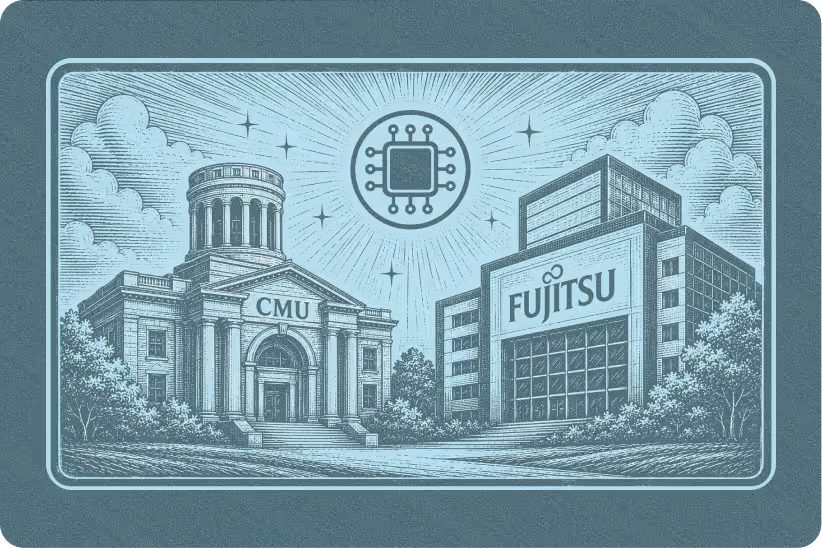
Artificial intelligence is moving beyond servers and screens. Carnegie Mellon University (CMU) and Fujitsu, a top Japanese IT provider, have partnered on an AI research center to revolutionize how machines interact with the physical world.
The Fujitsu-Carnegie Mellon Physical AI Research Center is devoted to creating AI-powered machines and robots that tackle critical issues like labor shortages and workplace safety. This groundbreaking partnership is a major leap toward bringing innovative physical AI solutions to real-world challenges.
This partnership demonstrates how embedding intelligence into real-world machines—and working together—drives true innovation across industries.
Bringing AI into the Physical World
Physical AI puts intelligence directly into robots and autonomous systems, allowing them to act, interact, and make decisions in the real world instead of just processing data behind screens.
With physical AI, machines can sense, decide, and act in real environments—handling obstacles and delicate tasks while making decisions on the spot. They move beyond computation to direct participation in the world.
Interest in physical AI is rapidly growing as experts turn to robotics and machine learning for practical solutions. The Fujitsu-CMU Center is the hub where these ideas become real-world innovations.
A State-of-the-Art Testing Ground
The research center is based at CMU’s advanced Robotics Innovation Center in Pittsburgh, offering top facilities for developing and testing physical AI systems.
The 150,000-square-foot facility equips researchers to rigorously develop and test physical AI systems, ensuring these machines are safe, reliable, and ready for real-world impact.
Solving the Global Labor Crisis
Global labor shortages are putting pressure on industries everywhere. Physical AI offers a real solution by enabling robots to handle repetitive or dangerous tasks, increasing productivity and safety while allowing people to focus on higher-value work.
Physical AI enables companies to boost productivity by deploying robots for repetitive or hazardous tasks, improving efficiency and workplace safety.
Physical AI empowers workers by handling tough, repetitive tasks. This lets people focus on safer, strategic roles and boosts overall efficiency.
Transforming Manufacturing and Logistics
Physical AI boosts manufacturing and logistics by helping robots quickly handle complex tasks like navigating warehouses, assembling parts, and managing inventory. This leads to faster, more reliable deliveries and efficient operations.
Unlike traditional robots, AI-powered machines quickly adapt to unexpected obstacles and changing environments.
These smart systems streamline tasks like loading, assembly, and inventory, making supply chains faster and more reliable.
Advancing Construction, Infrastructure, and Healthcare
Physical AI is revolutionizing construction, infrastructure, and healthcare by empowering robots to handle complex tasks, enhance safety, and support staff in critical roles.
In construction and infrastructure, robots handle heavy lifting, precise tasks, and structural inspections, improving safety and speeding up projects while preventing failures.
Physical AI also addresses healthcare staffing shortages by helping with patient transport, room cleaning, and supply management, allowing medical professionals to focus more on patient care.
The Power of Academic and Industry Partnerships
The Fujitsu-Carnegie Mellon Physical AI Research Center proves that major breakthroughs happen through strong academic and industry partnerships—achieving what neither could do alone.
Fujitsu brings deep IT expertise, while CMU leads in robotics, engineering, and AI research.
By combining CMU’s research innovation with Fujitsu’s industry know-how, this partnership rapidly turns groundbreaking AI and robotics ideas into real-world solutions that deliver real value.
Breaking Down Disciplinary Silos
Effective physical AI requires cross-disciplinary teamwork, combining expertise in engineering, robotics, language technologies, and ethics to tackle complex challenges.
Center experts in robotics, engineering, language technology, and ethics collaborate closely to ensure every physical AI system is advanced, safe, and reliable.
Why Collaboration and Standardization Matter
Physical AI still faces hurdles, like supply chain gaps and lack of standardization that keep robots and systems disconnected.
Without common standards and collaboration, physical AI systems stay isolated and can't scale across industries. The Fujitsu-CMU partnership is crucial for connecting these systems and enabling widespread adoption.
The Fujitsu-CMU partnership is driving physical AI forward by establishing standards and encouraging collaboration, making it easier for businesses to adopt and integrate smart machines across industries.
Building on a Legacy of AI Innovation
CMU advances AI by partnering with industry leaders to drive innovative research and real-world impact.
CMU’s recent collaboration with Bank of New York Mellon created a major AI Lab, while the university’s Learnvia platform now supports AI-driven learning at colleges nationwide.
Martial Hebert, dean of CMU’s School of Computer Science, says the new center strengthens CMU’s commitment to solving real-world problems through industry partnerships, ensuring innovations reach those who need them most.
Partner with FirstIgnite to Build the Future
The Fujitsu-Carnegie Mellon Physical AI Research Center proves that real progress comes from strong partnerships between industry and leading universities.
Partnering with leading institutions unlocks innovative AI and robotics solutions for your toughest business challenges.
Let FirstIgnite connect you with top academic partners to drive innovation and strategic growth.
Contact FirstIgnite to explore partnerships and accelerate innovation for your business.

.avif)
Connecting Industry & Academia
January 16, 2024
•
xx
MIN READ
FirstIgnite is supporting the commercialization of Mississippi State University’s Impact Wave Amplifier technology, a novel design in the field of cutting and demolition technologies which eliminates the need for expensive high-pressure seals and pumps. The advantages of this technology are that it is portable, customizable, efficient, affordable, and easy to maintain.
This technology is applicable to jackhammer amplifiers and any other device that could benefit from stress and pressure wave amplification. The global cutting equipment market size was $4.9 billion in 2023 and is projected to grow to $10.2 billion in 2032.
Mississippi State University’s Impact Wave Amplifier technology is ready for collaboration (licensing, partnerships, industry feedback, etc.). Is your company the right fit? If you’d be available for a conversation with the Mississippi State University team, you can schedule a time directly on their team’s calendar here.
Connecting Industry & Academia
New Horizons
AI Trends in Healthcare 2024
January 16, 2024
•
xx
MIN READ
The Impact of AI in Healthcare
The impact of AI in healthcare has been profound, with numerous applications that benefit both patients and medical professionals. One of the most significant areas where AI is making a difference is in diagnostics. AI-powered algorithms can analyze medical images, such as X-rays and MRIs, with remarkable accuracy, helping doctors detect diseases at an early stage. This not only saves lives but also reduces the cost and time associated with misdiagnosis.
AI is also revolutionizing drug discovery and development. By analyzing vast amounts of data, AI algorithms can identify patterns and predict the efficacy of potential drugs. This enables pharmaceutical companies to streamline their research and development efforts, bringing new treatments to market faster and at a lower cost. Additionally, AI is being used to personalize medicine by analyzing a patient's genetic information and tailoring treatments to their specific needs.
Healthcare Technology Trends for 2024
Looking ahead to 2024, we can expect several exciting healthcare technology trends that will shape the future of the industry. One such trend is the use of telemedicine and remote patient monitoring. With the advancements in AI and wearable devices, healthcare providers can remotely monitor patients' vital signs and detect any anomalies in real-time. This not only improves patient outcomes but also reduces the burden on hospitals and clinics, allowing them to allocate resources more efficiently.
Another trend to watch out for is the integration of AI-powered chatbots and virtual assistants in healthcare settings. These intelligent virtual agents can assist patients with routine inquiries, schedule appointments, and provide personalized health advice. By automating these tasks, healthcare professionals can focus on more complex cases, resulting in improved patient care.
University Research on AI in Healthcare
Universities and research institutions are at the forefront of AI advancements in healthcare. These institutions are conducting groundbreaking research and developing innovative technologies that have the potential to transform the healthcare landscape. For example, researchers at the University of Florida are exploring the use of AI in radiology to improve the accuracy and efficiency of medical imaging interpretation. AI algorithms can analyze medical images and detect abnormalities with a level of accuracy that rivals or surpasses human experts.
The Future of Healthcare Technology
The future of healthcare technology looks promising, with AI playing a central role in driving innovation. One area that holds great potential is precision medicine. By combining AI with genomics, researchers can identify genetic markers that predispose individuals to certain diseases. This knowledge can then be used to develop targeted therapies that are more effective and have fewer side effects. Precision medicine has the potential to revolutionize treatment outcomes, providing patients with personalized care based on their unique genetic makeup.
Another area where AI is set to make a significant impact is in the field of robotic surgery. AI-powered surgical robots can assist surgeons in performing complex procedures with greater precision and accuracy. These robots can analyze real-time data, provide guidance to surgeons, and even perform certain tasks autonomously. This not only reduces the risk of human error but also enables minimally invasive surgeries, leading to faster recovery times and reduced hospital stays.
Conclusion: The Potential of AI in Revolutionizing Healthcare
The potential of AI in revolutionizing healthcare is immense. From improving diagnostics and drug discovery to enabling precision medicine and remote patient monitoring, AI is transforming the way healthcare is delivered. The healthcare technology trends for 2024 discussed in this article are just a glimpse of what the future holds. As AI continues to evolve and become more sophisticated, we can expect even greater advancements that will benefit patients, healthcare professionals, and society as a whole.
Connecting Industry & Academia
From Scientific Text to Success- How FirstIgnite Transforms Complexity into Opportunity
January 5, 2024
•
xx
MIN READ
Introduction to FirstIgnite and its AI software
In today's fast-paced world, where information overload is the norm, it can be a daunting task to make sense of complex scientific research and turn it into actionable insights. This is where FirstIgnite's AI software comes into play, simplifying and summarizing scientific text to unlock hidden opportunities.
The power of AI in transforming scientific text
Artificial Intelligence (AI) has revolutionized various industries, and now it is making its mark in the realm of scientific research. FirstIgnite's AI software has the ability to analyze, understand, and summarize vast amounts of scientific text with remarkable accuracy and speed. By leveraging natural language processing and machine learning algorithms, FirstIgnite's AI software can extract key information from scientific papers, journals, and articles, saving researchers and professionals valuable time and effort.
Challenges in understanding and utilizing scientific research
Scientific research is often characterized by its complexity and technical jargon, which can be a barrier for non-experts in the field. Researchers and professionals face the challenge of understanding and utilizing scientific research to drive innovation and make informed decisions. Traditional approaches to reading and analyzing scientific text can be time-consuming and inefficient, leading to missed opportunities.
How FirstIgnite's AI software simplifies complex scientific text
FirstIgnite's AI software simplifies complex scientific text by providing concise summaries that capture the essence of the research. By employing advanced natural language processing algorithms, the software can identify the main ideas, key findings, and important concepts from scientific papers. Moreover, it translates technical jargon into industry terms, widening accessibility. This simplification process streamlines research, allowing professionals to focus on practical implications.
The benefits of using FirstIgnite for research institutions
Research institutions can greatly benefit from using FirstIgnite's AI software. By leveraging the power of AI, these institutions can streamline their research processes, accelerate discoveries, and enhance collaboration. The software's customizable output options allow researchers to tailor the summaries to their specific needs, ensuring that the most relevant information is highlighted. Additionally, the software's export and sharing features enable seamless collaboration and knowledge sharing among researchers, leading to increased productivity and innovation.
Customizable output options for easy understanding
The software offers customizable output, enabling users to tailor summaries to their preferences. Users can select their desired level of detail, from a concise overview to a more comprehensive analysis. This flexibility ensures ease of comprehension and information extraction, empowering individuals to make informed decisions.
Export and sharing features for collaboration and knowledge sharing
Collaboration and knowledge sharing are crucial in the world of scientific research. FirstIgnite's AI software facilitates this by providing export and sharing features. Researchers can export the summaries generated by the software, making it easy to integrate the information into their own workflow. Furthermore, the software enables seamless sharing of summaries with colleagues and potential collaborators, fostering collaboration and encouraging the exchange of ideas. This not only saves time but also promotes innovation and the generation of new insights.
Conclusion: Embracing the potential of AI in unlocking business opportunities
In today's data-driven world, the ability to extract valuable insights from scientific research is key to unlocking business opportunities. FirstIgnite's AI software simplifies this process by transforming complex scientific text into comprehensible summaries. By leveraging AI's potential, research institutions can streamline processes, expedite discoveries, and enhance collaboration. With customizable outputs and sharing capabilities, FirstIgnite empowers professionals to make informed decisions. Start with a free trial! - https://app.firstignite.com/register-account
Blogs
Connecting Industry & Academia
FirstIgnite
A Year of Achievements and Innovation
December 20, 2023
•
xx
MIN READ
As we wrap up an incredible year at FirstIgnite, we're thrilled to reflect on the milestones, recognitions, and product updates that have shaped our journey. Let's take a look back at some of the highlights from the past year:
Product Innovation and Launch
The highlight of the year was the successful launch of our product in 2023, introducing a suite of features that revolutionized the landscape of AI in education and beyond. The "Market Search" feature empowered users to effortlessly discover new markets for their inventions, streamlining research processes and facilitating data-driven decision-making. Alongside, our product boasted features such as company matching, people search, and summarization—making it a versatile tool for researchers, inventors, and industry professionals alike.
Recognition
In the realm of recognition and accolades, FirstIgnite soared high as a Top #EdTech Startup in the Midwest, acknowledged by Purpose Jobs. Additionally, our inclusion in Renaissance Venture Capital's Spring 2023 Startup Hotlist underscored our standing among the most promising early-stage companies in the region.
Events and Collaborations
Our year was marked by active participation in noteworthy events. From the skies above Traverse City, MI, to the iconic Big House in Ann Arbor, we shared the inspiring story of our CEO Chase Bonhag and engaged with the vibrant startup community during Michigan Tech Week. We had an amazing time atNorthern Michigan Startup Week, and our proud sponsorship at the NACRO conference showcased our commitment to connecting with experts in corporate relations. Additionally, we actively participated in various AUTM Meetings, contributing valuable insights into AI-enabled technology transfer and the marketing of intellectual property. Concluding the year on a high note, we participated in Renaissance Venture Capital's 2023 Fall UnDemo Day, a testament to our commitment to fostering meaningful collaborations within the startup ecosystem.
Community Engagement
Throughout these experiences, FirstIgnite remained dedicated to reshaping the landscape of AI in education and beyond. As we look to the future, our commitment to growth, collaboration, and industry impact remains unwavering. Thank you to our community for being an integral part of our journey!
Connecting Industry & Academia
Collaborate: Market Applications for New 2D Nanomaterials
December 7, 2023
•
xx
MIN READ
FirstIgnite is partnering with Drexel University to conduct market research regarding their family of two-dimensional (2D) inorganic materials, MXenes. MXenes encompass transitional metal carbides, nitrides, and carbonitrides, which display exceptional physical, chemical, electrochemical, and mechanical properties.
These materials have great potential across diverse sectors including energy, catalysis, optics, electronics, biomedical fields, electromagnetic applications, and environmental solutions.
Drexel University, where these 2D materials were discovered, is seeking market feedback on which application areas show the most promise for these material technologies. Is your company the right fit? If you’d be available for a conversation with the Drexel University team, you can schedule a time directly on their team’s calendar here.
Blogs
Connecting Industry & Academia
Utilizing FirstIgnite for Market Research in Healthcare & Medical Devices
December 1, 2023
•
xx
MIN READ
Understanding the market applicability of your innovations is important for successful integration and adoption within specific industries. Identifying the audience, niches, and industries interested in the application of your research or product is crucial for its successful commercialization and impact.
Effective market research enables you to align your initiatives with market demands, tailoring your approach for optimal outcomes. It's about finding the right fit between your innovation and the needs of potential consumers or industries.
For instance, the healthcare and medical devices market, with a growth rate of 5.9% and a market size exceeding $550 billion, presents opportunities. The true opportunity lies in the transformative impact these innovations can have on healthcare delivery and patient outcomes.

The healthcare sector continually seeks cutting-edge technologies, devices, and diagnostic tools to enhance early detection, enable less invasive procedures, and improve treatment efficacy. It's a space where innovative advancements play an important role in revolutionizing patient care.
To navigate this complex landscape and determine market applicability, tools like FirstIgnite's market search feature prove to be valuable. This software goes beyond showcasing market potential; it provides detailed insights into market segments, identifies major players, highlights niche companies, and forecasts growth trajectories.
By leveraging this tool, offices can streamline their market research efforts significantly. They save valuable time in identifying potential markets and gain actionable insights crucial for making informed, data-driven decisions. Moreover, FirstIgnite's functionality to export comprehensive market reports through shareable links allows teams to collaborate seamlessly. This feature enables effortless sharing of critical market insights within organizations or among stakeholders, fostering efficient decision-making processes and facilitating broader discussions to maximize the potential impact of their innovations.
Blogs
Connecting Industry & Academia
FirstIgnite Recognized as Top EdTech Startup in the Midwest by Purpose Jobs
November 29, 2023
•
xx
MIN READ
The landscape of education is rapidly evolving, embracing technology to enhance learning experiences and empower institutions. In a recent acknowledgment of innovation, FirstIgnite has been honored as a leading EdTech startup in the Midwest by Purpose Jobs, standing among 27 companies transforming education in emerging tech hubs.
Since our establishment in 2019, FirstIgnite has been at the forefront of developing AI-powered research commercialization tools tailored for universities. Being recognized among 27 EdTech companies is not just an honor but a validation of our pursuit of excellence. We are humbled to stand alongside other trailblazers in embracing transformative technologies.
This recognition from Purpose Jobs highlights not only our achievements but also our dedication to reimagining traditional educational models. It motivates us to continue pioneering AI-driven tools and tailored solutions that cater to the evolving needs of educational institutions.
At FirstIgnite, we believe in the power of technology to revolutionize academia. Our inclusion in this list further fuels our commitment to expanding horizons, pushing boundaries, and leveraging technology.
We are dedicated to evolving, innovating, and shaping a future where academia, and the research they conduct, is more accessible, innovative, and impactful for all.
Connecting Industry & Academia
Collaborate: Vortex Generation and Flow Deflection Devices for Outdoor Solar Panel Convective Cooling
November 17, 2023
•
xx
MIN READ
FirstIgnite is supporting the commercialization of Portland State University’s vortex generation and flow deflection devices for outdoor solar panel convective cooling technology, which induces turbulence and improves surface cooling of solar panels by more than 50%. Leveraging turbulent boundary layer dynamics, this technology fosters convective cooling while remaining easily adaptable to current solar panel setups due to its modular design.
This technology is applicable across various sectors, particularly in enhancing the efficiency of solar photovoltaic plants by integrating seamlessly into existing panel designs. Its application extends beyond solar energy, having potential in cooling systems in industries like electronics and aviation. The solar energy systems market, which was worth $189.15 billion in 2022, is expected to reach $USD 837.28 billion by 2032.
Portland State University’s vortex generation and flow deflection devices for outdoor solar panel convective cooling technology is ready for collaboration (licensing, partnerships, industry feedback, etc.). Is your company the right fit? If you’d be available for a conversation with the Portland State University team, you can schedule a time directly on their team’s calendar here.
Connecting Industry & Academia
Collaborate: Ceramic Wickless Vapor Chambers for Thermal Management
November 3, 2023
•
xx
MIN READ
FirstIgnite is supporting the commercialization of the University of Illinois at Chicago’s ceramic wickless vapor chambers for thermal management technology, in which the ceramic material used has a thermal expansion coefficient nearer matched to that of the silicon substrate than conventional metallic heat sinks. This technology has high thermal conductivity, low electrical conductivity to prevent short-circuits, and thermal expansion coefficients similar to silicon, reducing heat-induced mechanical failures.
This technology is applicable to microelectronics manufacturing for advanced thermal management solutions, high-performance computing systems requiring efficient heat dissipation, and portable electronic devices that require safe, reliable, and compact thermal management systems. The thermal management market was worth $10.7 billion in 2022 and is expected to reach $19.3 billion by 2028.
The University of Illinois at Chicago’s ceramic wickless vapor chambers for thermal management technology is ready for collaboration (licensing, partnerships, industry feedback, etc.). Is your company the right fit? If you’d be available for a conversation with the University of Illinois at Chicago team, you can schedule a time directly on their team’s calendar here.
Connecting Industry & Academia
Collaborate: Portable Osteometric Device
October 27, 2023
•
xx
MIN READ
FirstIgnite is supporting the commercialization of Mississippi State University’s Portable Osteometric Device technology, which is a portable device that uses laser sensors with time-of-flight technology to measure human skeletal material. The advantages of this technology are that it is cost effective, easy to transport, provides accurate and precise measurements, and it reduces reading errors.
This technology improves upon traditional measuring devices used in anthropology, archaeology, zoology, and forensics by improving the analysis of skeletal remains, including bone length. It aids in answering historical questions and identifying human remains for legal and forensic purposes, including human rights violations and repatriation efforts. The global forensic technology market size was valued at $4.88 billion in 2022 and is expected to increase to $10.65 billion in 2030.
Mississippi State University’s Portable Osteometric Device technology is ready for collaboration (licensing, partnerships, industry feedback, etc.). Is your company the right fit? If you’d be available for a conversation with the Mississippi State University team, you can schedule a time directly on their team’s calendar here.
Connecting Industry & Academia
Collaborate: DriVR
October 27, 2023
•
xx
MIN READ
FirstIgnite is supporting the commercialization of Mississippi State University’s DriVR technology, which is a virtual reality (VR) software application that prepares individuals with disabilities for real-world driving, with personalized scenarios to boost confidence, decrease anxiety, and enhance independence and employment prospects.
This technology is applicable to rehabilitation programs for people with disabilities, schools or other institutions teaching driving skills to people with disabilities, and personal use by individuals with disabilities keen to learn how to drive. The global virtual reality in healthcare market was worth $2.14 billion in 2019 and is expected to reach $33.72 billion by 2027.
Mississippi State University’s DriVR technology is ready for collaboration (licensing, partnerships, industry feedback, etc.). Is your company the right fit? If you’d be available for a conversation with the Mississippi State University team, you can schedule a time directly on their team’s calendar here.
Connecting Industry & Academia
Collaborate: Box Level Effusion Cell for Outgassing Measurements
October 27, 2023
•
xx
MIN READ
FirstIgnite is supporting the commercialization of Johns Hopkins University Applied Physics Laboratory’s Box Level Effusion Cell for Outgassing Measurements technology. This cell offers precise thermal control (+/- 2°C) for large masses (~10 kg) through a unique "trapdoor" design that optimizes vacuum conductance during the bakeout phase for the hardware and isolates hardware during outgassing measurements.
This technology is versatile, enabling outgassing environment quantification for space mission hardware and aiding launch providers in meeting outgassing requirements for shared payloads. The global space launch services market was worth $16.9 billion in 2022 and is expected to reach $29.6 billion by 2027.
Johns Hopkins University’s Box Level Effusion Cell for Outgassing Measurements technology is ready for collaboration (licensing, partnerships, industry feedback, etc.). Is your company the right fit? If you’d be available for a conversation with the Johns Hopkins University team, you can schedule a time directly on their team’s calendar here.