


RESOURCES
Blogs
Insights, strategies, and updates on research commercialization, university innovation, industry partnerships, and AI-powered prospecting
Connecting Industry & Academia
CMU and Fujitsu Launch Physical AI Research Center
April 27, 2026
•
xx
MIN READ
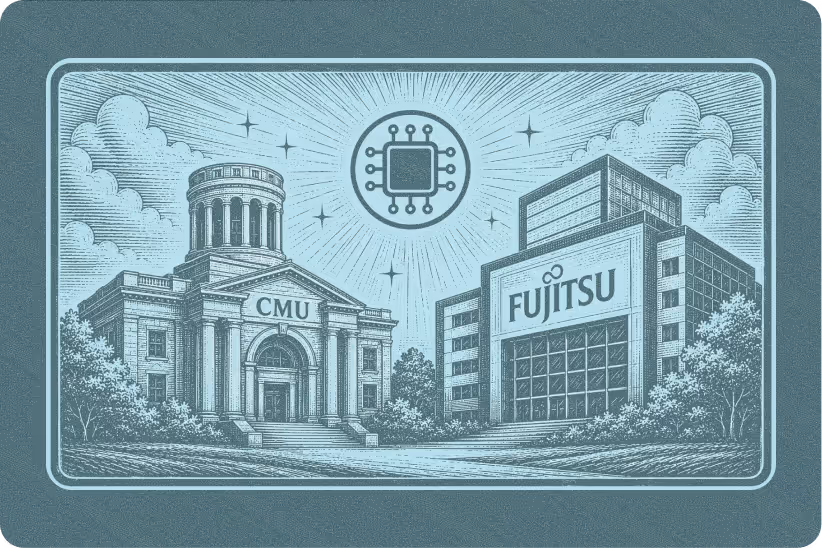
Artificial intelligence is moving beyond servers and screens. Carnegie Mellon University (CMU) and Fujitsu, a top Japanese IT provider, have partnered on an AI research center to revolutionize how machines interact with the physical world.
The Fujitsu-Carnegie Mellon Physical AI Research Center is devoted to creating AI-powered machines and robots that tackle critical issues like labor shortages and workplace safety. This groundbreaking partnership is a major leap toward bringing innovative physical AI solutions to real-world challenges.
This partnership demonstrates how embedding intelligence into real-world machines—and working together—drives true innovation across industries.
Bringing AI into the Physical World
Physical AI puts intelligence directly into robots and autonomous systems, allowing them to act, interact, and make decisions in the real world instead of just processing data behind screens.
With physical AI, machines can sense, decide, and act in real environments—handling obstacles and delicate tasks while making decisions on the spot. They move beyond computation to direct participation in the world.
Interest in physical AI is rapidly growing as experts turn to robotics and machine learning for practical solutions. The Fujitsu-CMU Center is the hub where these ideas become real-world innovations.
A State-of-the-Art Testing Ground
The research center is based at CMU’s advanced Robotics Innovation Center in Pittsburgh, offering top facilities for developing and testing physical AI systems.
The 150,000-square-foot facility equips researchers to rigorously develop and test physical AI systems, ensuring these machines are safe, reliable, and ready for real-world impact.
Solving the Global Labor Crisis
Global labor shortages are putting pressure on industries everywhere. Physical AI offers a real solution by enabling robots to handle repetitive or dangerous tasks, increasing productivity and safety while allowing people to focus on higher-value work.
Physical AI enables companies to boost productivity by deploying robots for repetitive or hazardous tasks, improving efficiency and workplace safety.
Physical AI empowers workers by handling tough, repetitive tasks. This lets people focus on safer, strategic roles and boosts overall efficiency.
Transforming Manufacturing and Logistics
Physical AI boosts manufacturing and logistics by helping robots quickly handle complex tasks like navigating warehouses, assembling parts, and managing inventory. This leads to faster, more reliable deliveries and efficient operations.
Unlike traditional robots, AI-powered machines quickly adapt to unexpected obstacles and changing environments.
These smart systems streamline tasks like loading, assembly, and inventory, making supply chains faster and more reliable.
Advancing Construction, Infrastructure, and Healthcare
Physical AI is revolutionizing construction, infrastructure, and healthcare by empowering robots to handle complex tasks, enhance safety, and support staff in critical roles.
In construction and infrastructure, robots handle heavy lifting, precise tasks, and structural inspections, improving safety and speeding up projects while preventing failures.
Physical AI also addresses healthcare staffing shortages by helping with patient transport, room cleaning, and supply management, allowing medical professionals to focus more on patient care.
The Power of Academic and Industry Partnerships
The Fujitsu-Carnegie Mellon Physical AI Research Center proves that major breakthroughs happen through strong academic and industry partnerships—achieving what neither could do alone.
Fujitsu brings deep IT expertise, while CMU leads in robotics, engineering, and AI research.
By combining CMU’s research innovation with Fujitsu’s industry know-how, this partnership rapidly turns groundbreaking AI and robotics ideas into real-world solutions that deliver real value.
Breaking Down Disciplinary Silos
Effective physical AI requires cross-disciplinary teamwork, combining expertise in engineering, robotics, language technologies, and ethics to tackle complex challenges.
Center experts in robotics, engineering, language technology, and ethics collaborate closely to ensure every physical AI system is advanced, safe, and reliable.
Why Collaboration and Standardization Matter
Physical AI still faces hurdles, like supply chain gaps and lack of standardization that keep robots and systems disconnected.
Without common standards and collaboration, physical AI systems stay isolated and can't scale across industries. The Fujitsu-CMU partnership is crucial for connecting these systems and enabling widespread adoption.
The Fujitsu-CMU partnership is driving physical AI forward by establishing standards and encouraging collaboration, making it easier for businesses to adopt and integrate smart machines across industries.
Building on a Legacy of AI Innovation
CMU advances AI by partnering with industry leaders to drive innovative research and real-world impact.
CMU’s recent collaboration with Bank of New York Mellon created a major AI Lab, while the university’s Learnvia platform now supports AI-driven learning at colleges nationwide.
Martial Hebert, dean of CMU’s School of Computer Science, says the new center strengthens CMU’s commitment to solving real-world problems through industry partnerships, ensuring innovations reach those who need them most.
Partner with FirstIgnite to Build the Future
The Fujitsu-Carnegie Mellon Physical AI Research Center proves that real progress comes from strong partnerships between industry and leading universities.
Partnering with leading institutions unlocks innovative AI and robotics solutions for your toughest business challenges.
Let FirstIgnite connect you with top academic partners to drive innovation and strategic growth.
Contact FirstIgnite to explore partnerships and accelerate innovation for your business.

.avif)
University
April 17, 2023
•
xx
MIN READ
FirstIgnite is supporting the commercialization of Florida International University’s new fluorescent hydrogels for drug delivery technology. This technology utilizes nanoparticles and microparticles that exhibit multi-channel fluorescence properties, setting them apart as a distinctive imaging agent that can be detected by a wide range of instruments. This technology offers numerous advantages, such as excellent biocompatibility, cell uptake and surface functionality, and eliminates the need for extra fluorescent labels. It is also compatible with various instruments, making it a valuable tool in drug delivery technology.
This technology is applicable to targeted drug delivery and image-guided therapy, bio-sensing, in vivo drug monitoring and diagnosis. The global pharmaceutical drug delivery market size was valued at $1,525.16 billion in 2022 and is projected to exceed $2,047.36 billion by 2030.
Florida International University’s fluorescent hydrogels for drug delivery technology is ready for collaboration (licensing, partnerships, industry feedback, etc.). Is your company the right fit? If you’d be available for a conversation with the Florida International University team, you can schedule a time directly on their team’s calendar here.
Groundbreaking University Innovations
University
When University Innovation Changed the World: Synthetic Taxol
April 17, 2023
•
xx
MIN READ
Did you know that a professor at Florida State University invented synthetic Taxol? Dr. Robert Holton invented the synthetic version of the life-saving cancer drug.
Breast cancer, which currently accounts for 12.5% of all new annual cancer cases worldwide, is the most common cancer globally. Treatment for breast cancer often involves the use of Taxol, a drug that stops cancer cells from dividing into two new cells. Prior to the invention of synthetic Taxol, the anti-cancer medication could only be sourced from the slow-growing Pacific Yew tree, which could be difficult and costly to obtain. However, in 1993, Dr. Holton developed a synthetic version of Taxol, eliminating the need for the Pacific Yew. This breakthrough resulted in the top-selling anti-cancer drug of 1995, generating over $1.6 billion in revenue by the end of the decade.
Dr. Holton's invention of synthetic Taxol has not only successfully treated patients in the past, but it continues to be used today. The global market for Paclitaxel, the generic name of Taxol, was valued at $4.51 billion in 2021 and is projected to grow to over $11.16 billion by 2030. This growth shows the continued importance and demand for this life-saving drug that came from university innovation.
Through their research and development efforts, universities have paved the way for significant breakthroughs. Keeping up with university innovation is crucial to your organization’s competitiveness as it allows you to identify new technologies that can help to give you a competitive edge in the market. FirstIgnite can help your organization identify and partner with the specific universities, laboratories, and experts you need in order to discover the next medical breakthrough like synthetic Taxol.
University
Collaborate: Robotic Arm Sensor
April 17, 2023
•
xx
MIN READ
FirstIgnite is supporting the commercialization of Colorado State University's robotic arm sensor for validations in manufacturing technology. This technology provides a four-fold hybrid validation system for custom manufacturing processes, which includes inspection, authentication, and forensic validation. All of these validation methods are possible with the same robotic arm supported sensor. By implementing this robotic arm sensor, manufacturers will be able to save time, streamline their processes, and prevent fraud.
This technology has a wide range of applications, including 3D printing and other manufacturing applications, custom manufacturing validation (forensics of failure-unreadable indents may indicate stress concentrations), manufacturing quality control (can help identify vulnerabilities in the manufacturing process), asserting copyright (similar to a watermark that is expensive to remove for fraudulent agents), and binding of dissimilar parts. The global industrial sensors market size was worth $23 billion in 2021 and is expected to reach $41 billion by 2030, indicating potential for growth of this technology.
Colorado State University’s robotic arm sensor technology is ready for collaboration (licensing, partnerships, industry feedback, etc.). Is your company the right fit? If you’d be available for a conversation with the Colorado State University team, you can schedule a time directly on their team’s calendar here.
University
Collaborate: Disease-Resistant Potatoes
April 17, 2023
•
xx
MIN READ
FirstIgnite is supporting the commercialization of Colorado State University's technology for disease-resistant potatoes. This innovative technology involves novel protease inhibitors extracted from a wild potato species. These inhibitors possess disease-resistant properties and offer baseline genetic resistance to soft rot in potatoes, making the technology valuable in the field of agriculture.
This technology is applicable to integrating genetic resistance to soft rot pathogens into potatoes and related crops as well as antimicrobial products for food safety. In 2021, the antimicrobial additives market was valued at $4 billion and is expected to increase to $5.5 billion by 2026.
Colorado State University’s technology for disease-resistant potatoes is ready for collaboration (licensing, partnerships, industry feedback, etc.). Is your company the right fit? If you’d be available for a conversation with the Colorado State University team, you can schedule a time directly on their team’s calendar here.
Connecting Industry & Academia
FirstIgnite Launches Revolutionary Software to Bridge the Gap between Scientific Research and Industry
April 17, 2023
•
xx
MIN READ
Introducing FirstIgnite: A Game-Changing Platform for Scientific Research Marketing
We are excited to announce the official launch of our groundbreaking software product designed to revolutionize the way scientific research is marketed and utilized by industry professionals. As a leader in the field of scientific research marketing, our mission is to bridge the gap between scientific knowledge and industry application, fostering innovation and collaboration between these two vital sectors.
Revolutionary Technology for Summarizing and Matching Research
FirstIgnite is an innovative platform that employs advanced algorithms and artificial intelligence to transform scientific research into concise marketing summaries. Our software matches these summaries to companies based on their specific needs and interests, enabling universities to quickly market their latest scientific advancements and identify potential industry collaborations.
Our proprietary technology allows us to extract key insights, analyze complex data, and generate easy-to-understand summaries, saving universities time and resources in their search for industry partners. Our platform covers a wide range of fields, including pharmaceuticals, biotechnology, materials science, environmental sciences, and many more.
A Comprehensive Database of Scientific Articles
We have meticulously curated a vast database of scientific articles from reputable journals, research institutions, and conferences, ensuring the highest quality and relevance for our users. We continually update our content to provide the most current and groundbreaking research.
Exclusive Introductory Offer for New Users
To celebrate the launch of FirstIgnite, we are offering exclusive introductory pricing for new users. Sign up now to experience the full capabilities of our product firsthand and see how it can revolutionize your approach to scientific research marketing.
Join Us on This Exciting Journey
At FirstIgnite, we are dedicated to driving innovation and facilitating collaboration between the scientific community and the business world. We believe our platform will transform the way companies access and utilize scientific research for their strategic decision-making.
Don't miss out on this game-changing opportunity! Visit our website at www.firstignite.com to learn more and sign up for a demo today. For any inquiries or assistance, feel free to reach out to david@firstignite.com.
Thank you for your continued support, and we look forward to having you join us on this exciting journey with FirstIgnite!
University
Collaborate: Wearable Cortisol Sensing
April 11, 2023
•
xx
MIN READ
FirstIgnite is supporting the commercialization of Florida International University’s new wearable cortisol sensing technology that utilizes a simple, label-free, and cost-effective optical detection technique for cortisol sensing through UV LED technology. Unlike other cortisol sensing technologies that often require complex synthesis and fabrication processes, this technology offers a fast and efficient solution.
The wearable cortisol sensing technology is able to monitor cortisol level for personal health monitoring and diagnosis with point-of-care detection. This technology can contribute to the growing global digital patient monitoring devices market, which is predicted to reach around $451.54 billion by 2030, up from its value of around $80.61 billion in 2021.
Florida International University’s wearable cortisol sensing technology is ready for collaboration (licensing, partnerships, industry feedback, etc.). Is your company the right fit? If you’d be available for a conversation with the Florida International University team, you can schedule a time directly on their team’s calendar here.
Blogs
Events
Convention Spotlight: BCI 2023
April 5, 2023
•
xx
MIN READ
Are you in the battery industry and looking to stay up-to-date with the latest trends and innovations? Look no further than the Battery Council International 2023 convention, the premier event for battery industry professionals. From April 23-26 in Louisville, Kentucky, BCI 2023 will host top companies, researchers, and experts in the battery industry to discuss the latest technologies, industry challenges, and future trends. Attendees can expect engaging keynote speeches, informative panel discussions, and valuable networking opportunities.
One of the most valuable aspects of attending BCI 2023 will be the networking opportunities. Attendees will have the chance to connect with other industry professionals, including exhibitors, speakers, and fellow attendees. The convention will have several dedicated networking events, including the welcome reception and closing reception. Attendees can also network during breaks between sessions and in the exhibit hall. Some of the exhibitors attending this year's conference include JBI Corporation, Eagle Oxide Services, and Wirtz Manufacturing, offering attendees the chance to engage with important players in their respective fields.
At FirstIgnite, we are proud to support a variety of universities’ battery technologies. Currently, we are supporting the University of Alabama’s EV battery power system technology. Our commitment to partnering with the University of Alabama demonstrates our dedication to driving breakthroughs in the battery industry. Curious to learn more about FirstIgnite’s services for battery research? Please schedule time with our team directly here.
Blogs
Events
Trade Show Spotlight: FIME 2023
April 5, 2023
•
xx
MIN READ
The Florida International Medical Expo (FIME), the largest trade event for medical device and equipment manufacturers, suppliers, and distributors in the Americas, will be held in Miami, Florida, from June 21-23, 2023. With over 12,000 trade professionals from more than 110 countries attending, this event is a must-attend for healthcare companies.
In 2022, the show floor generated $106 million worth of business, and they are offering opportunities for new business connections in 2023. This event is the perfect platform for companies looking to expand their network, connect with potential clients, and forge new partnerships with other industry players. This year's exhibitors include industry leaders such as Philips Medical Systems, Steris, and Surtex Instruments.
At FirstIgnite, we are proud to support a variety of universities' medical device technologies. Currently, we are supporting Stony Brook University’s virtual pancreatography technology, Drexel University’s sternotomy patch & saw guide technology, and the University of Alberta’s MRI liner technology. Our commitment to partnering with these institutions demonstrates our dedication to driving breakthroughs in the medical device industry. Curious to learn more about FirstIgnite’s services for medical device research? Please schedule time with our team directly here.
Blogs
New Horizons
New Horizons: Laser Processing
April 3, 2023
•
xx
MIN READ
Due to technological advancements and increased usage of lasers in medical devices and manufacturing applications, the demand for laser processing is on the rise. Laser processing involves the use of lasers to modify the surface or properties of materials. In 2021, the global laser processing market was valued at $17.5 billion and is projected to reach $38.22 billion by 2030.
Laser processing is a technology with applications in various industries such as automotive, aerospace, machine tools, electronics, medical, and packaging. Laser cutting offers several advantages, including flexibility, precision, repeatability, speed, cost-effectiveness, superior quality, contactless cutting, versatility, and automation possibilities. Due to these benefits, laser processing tools have gained the attention of venture capitalists. For example, in 2020, an investment of $5.5 million was made by Beringea in the laser optics company, Micro-LAM.
In the laser processing sector, there are many companies operating, with some of the top players being Altec ($3.5 billion in revenue as of 2021), Newport Corporation ($2.9 billion in revenue as of 2021), and IPG Photonics ($1.46 billion in revenue as of 2022).
As revenue and funding for laser processing companies continue to grow, it has become increasingly important for universities to establish innovation partnerships with them in order to stay ahead. FirstIgnite can help your university identify and partner with the laser processing companies you need to further your research and development.
Blogs
Connecting Industry & Academia
Introducing FirstIgnite's Technology Briefs
March 29, 2023
•
xx
MIN READ
As the world of technology continues to grow exponentially, universities are at the forefront of groundbreaking research and developments. One of the challenges that these institutions face is effectively showcasing their technology portfolios to potential investors, industry partners, and the general public. That's where FirstIgnite comes in. We are excited to announce our latest service offering, Technology Briefs, designed to create powerful, simple-to-read synopses of your university's technology portfolio.
Why Technology Briefs?
Universities often have a wealth of technology innovations, but presenting them in an easy-to-understand and appealing format can be a challenge. Traditional methods of displaying technology portfolios can be overwhelming, confusing, or simply uninteresting to readers. FirstIgnite's Technology Briefs service tackles this problem by creating concise, engaging, and informative synopsis that highlight the key aspects of each technology in your portfolio.
The Benefits of FirstIgnite's Technology Briefs
1. Simplified Communication: Our Technology Briefs distill complex technologies into straightforward and easy-to-understand descriptions, allowing readers to quickly grasp the significance and potential applications of each innovation.
2. Enhanced Engagement: By presenting your university's technology portfolio in an appealing format, you'll attract the attention of potential investors, industry partners, and the public. This increased engagement can lead to new partnerships, funding opportunities, and increased visibility for your institution.
3. Customized Solutions: Our team of experts will work closely with your university to understand your specific needs and goals. We will tailor our Technology Briefs to highlight the most relevant aspects of your technology portfolio, ensuring that your target audience finds them valuable and engaging.
4. Time and Cost-Effective: By outsourcing the creation of your Technology Briefs to FirstIgnite, your university can save valuable time and resources that can be better spent on research and development.
How FirstIgnite's Technology Briefs Work
Our team of experienced technical writers and industry experts will collaborate with your university's representatives to gather information about your technology portfolio. We will then create compelling and concise synopses that highlight the most important aspects of each technology, such as potential applications, benefits, and competitive advantages.
Once your Technology Briefs are complete, your university can easily integrate them into your existing marketing materials, such as websites, brochures, and presentations. These synopses will serve as powerful tools for showcasing your university's innovations and attracting the attention of potential partners and investors.
Get Started with FirstIgnite's Technology Briefs Today
Don't let your university's groundbreaking technology innovations go unnoticed. With FirstIgnite's Technology Briefs service, you can effectively showcase your technology portfolio in a concise and engaging format that will capture the attention of your target audience. Contact us today to learn more about how FirstIgnite can help transform your university's technology portfolio and unlock new opportunities for growth and success.
Contact us today for a free sample of a technology brief!
University
Collaborate: Decarbonized Biomanufacturing
March 27, 2023
•
xx
MIN READ
FirstIgnite is supporting the commercialization of Washington University in St. Louis’s decarbonized biomanufacturing technology, which efficiently and cost-effectively valorizes waste CO2. This technology allows for the manufacturing of bioplastics, chemicals, fuels, and proteins from CO2. Additionally, the technology includes enzyme-based electro-bio conversion engineering systems and carbon capture and delivery system design, resulting in rapid and efficient conversion of CO2 into value-added products. Techno-economic, life cycle, environmental, and social impact analyses are also conducted to improve the efficiency of CO2 conversion systems.
This technology is applicable to bulk chemical production, pharmaceutical production, food and beverage production, and any practice that yields high carbon emissions. The global chemical distribution market size is valued at $256.69 billion in 2023 and is expected to reach $403.22 billion by 2030.
Washington University in St. Louis’s decarbonized biomanufacturing technology is ready for collaboration (licensing, partnerships, industry feedback, etc.). Is your company the right fit? If you’d be available for a conversation with the Washington University in St. Louis team, you can schedule a time directly on their team’s calendar here.
Blogs
Events
Conference Spotlight: ARVO Annual Meeting
March 22, 2023
•
xx
MIN READ
The Association for Research in Vision and Ophthalmology (ARVO) is the world's largest organization dedicated to eye and vision research. With a membership of nearly 10,000 researchers hailing from over 75 countries, this association is at the forefront of advancing global research into the visual system, including the prevention, treatment, and cure of its disorders.
The ARVO Annual Meeting, a significant event in the field of ophthalmology, will be taking place from April 23 to 27, 2023, in New Orleans, Louisiana. This gathering of researchers and industry professionals from around the world offers an opportunity for collaboration, sharing of knowledge, and advancing the field of vision and ophthalmology. Notable companies in attendance this year include Allergan, Janssen Pharmaceuticals, and Nidek.
At FirstIgnite, we are proud to support Florida International University's device for assisting visually impaired patients. The device targets individuals with central and peripheral vision impairments, such as those with AMD and glaucoma. Our commitment to partnering with institutions like FIU demonstrates our dedication to driving breakthroughs in the field of vision and ophthalmology. Curious to learn more about FirstIgnite's services for ophthalmology research? Please schedule time with our team directly here.