


RESOURCES
Blogs
Insights, strategies, and updates on research commercialization, university innovation, industry partnerships, and AI-powered prospecting
Connecting Industry & Academia
CMU and Fujitsu Launch Physical AI Research Center
April 27, 2026
•
xx
MIN READ
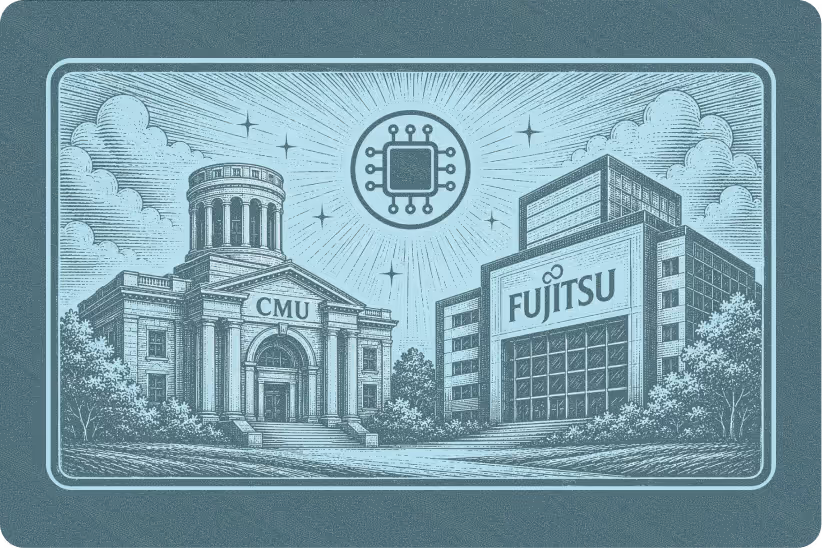
Artificial intelligence is moving beyond servers and screens. Carnegie Mellon University (CMU) and Fujitsu, a top Japanese IT provider, have partnered on an AI research center to revolutionize how machines interact with the physical world.
The Fujitsu-Carnegie Mellon Physical AI Research Center is devoted to creating AI-powered machines and robots that tackle critical issues like labor shortages and workplace safety. This groundbreaking partnership is a major leap toward bringing innovative physical AI solutions to real-world challenges.
This partnership demonstrates how embedding intelligence into real-world machines—and working together—drives true innovation across industries.
Bringing AI into the Physical World
Physical AI puts intelligence directly into robots and autonomous systems, allowing them to act, interact, and make decisions in the real world instead of just processing data behind screens.
With physical AI, machines can sense, decide, and act in real environments—handling obstacles and delicate tasks while making decisions on the spot. They move beyond computation to direct participation in the world.
Interest in physical AI is rapidly growing as experts turn to robotics and machine learning for practical solutions. The Fujitsu-CMU Center is the hub where these ideas become real-world innovations.
A State-of-the-Art Testing Ground
The research center is based at CMU’s advanced Robotics Innovation Center in Pittsburgh, offering top facilities for developing and testing physical AI systems.
The 150,000-square-foot facility equips researchers to rigorously develop and test physical AI systems, ensuring these machines are safe, reliable, and ready for real-world impact.
Solving the Global Labor Crisis
Global labor shortages are putting pressure on industries everywhere. Physical AI offers a real solution by enabling robots to handle repetitive or dangerous tasks, increasing productivity and safety while allowing people to focus on higher-value work.
Physical AI enables companies to boost productivity by deploying robots for repetitive or hazardous tasks, improving efficiency and workplace safety.
Physical AI empowers workers by handling tough, repetitive tasks. This lets people focus on safer, strategic roles and boosts overall efficiency.
Transforming Manufacturing and Logistics
Physical AI boosts manufacturing and logistics by helping robots quickly handle complex tasks like navigating warehouses, assembling parts, and managing inventory. This leads to faster, more reliable deliveries and efficient operations.
Unlike traditional robots, AI-powered machines quickly adapt to unexpected obstacles and changing environments.
These smart systems streamline tasks like loading, assembly, and inventory, making supply chains faster and more reliable.
Advancing Construction, Infrastructure, and Healthcare
Physical AI is revolutionizing construction, infrastructure, and healthcare by empowering robots to handle complex tasks, enhance safety, and support staff in critical roles.
In construction and infrastructure, robots handle heavy lifting, precise tasks, and structural inspections, improving safety and speeding up projects while preventing failures.
Physical AI also addresses healthcare staffing shortages by helping with patient transport, room cleaning, and supply management, allowing medical professionals to focus more on patient care.
The Power of Academic and Industry Partnerships
The Fujitsu-Carnegie Mellon Physical AI Research Center proves that major breakthroughs happen through strong academic and industry partnerships—achieving what neither could do alone.
Fujitsu brings deep IT expertise, while CMU leads in robotics, engineering, and AI research.
By combining CMU’s research innovation with Fujitsu’s industry know-how, this partnership rapidly turns groundbreaking AI and robotics ideas into real-world solutions that deliver real value.
Breaking Down Disciplinary Silos
Effective physical AI requires cross-disciplinary teamwork, combining expertise in engineering, robotics, language technologies, and ethics to tackle complex challenges.
Center experts in robotics, engineering, language technology, and ethics collaborate closely to ensure every physical AI system is advanced, safe, and reliable.
Why Collaboration and Standardization Matter
Physical AI still faces hurdles, like supply chain gaps and lack of standardization that keep robots and systems disconnected.
Without common standards and collaboration, physical AI systems stay isolated and can't scale across industries. The Fujitsu-CMU partnership is crucial for connecting these systems and enabling widespread adoption.
The Fujitsu-CMU partnership is driving physical AI forward by establishing standards and encouraging collaboration, making it easier for businesses to adopt and integrate smart machines across industries.
Building on a Legacy of AI Innovation
CMU advances AI by partnering with industry leaders to drive innovative research and real-world impact.
CMU’s recent collaboration with Bank of New York Mellon created a major AI Lab, while the university’s Learnvia platform now supports AI-driven learning at colleges nationwide.
Martial Hebert, dean of CMU’s School of Computer Science, says the new center strengthens CMU’s commitment to solving real-world problems through industry partnerships, ensuring innovations reach those who need them most.
Partner with FirstIgnite to Build the Future
The Fujitsu-Carnegie Mellon Physical AI Research Center proves that real progress comes from strong partnerships between industry and leading universities.
Partnering with leading institutions unlocks innovative AI and robotics solutions for your toughest business challenges.
Let FirstIgnite connect you with top academic partners to drive innovation and strategic growth.
Contact FirstIgnite to explore partnerships and accelerate innovation for your business.

.avif)
University
March 20, 2023
•
xx
MIN READ
FirstIgnite is supporting the commercialization of Auburn University’s configurable and serviceable respirator technology. Featuring standardized fittings and easy assembly and disassembly, this respirator system allows for greater part interchangeability between half- and full-face configurations. This technology is adaptable, reusable, convenient, and comfortable.
This technology provides ideal personal protective equipment for medical, commercial, industrial, and personal applications. The global personal protective equipment (PPE) market is expected to grow from $80.38 billion in 2022 to $110.85 billion by 2029.
Auburn University’s configurable and serviceable respirator technology is ready for collaboration (licensing, partnerships, industry feedback, etc.). Is your company the right fit? If you’d be available for a conversation with the Auburn University team, you can schedule a time directly on their team’s calendar here.
University
Collaborate: Virtual Pancreatography
March 17, 2023
•
xx
MIN READ
FirstIgnite is supporting the commercialization of Stony Brook University's virtual pancreatography technology, which uses imaging information to identify cysts and applies a first and second classifier to sort them into multiple cystic lesion types. This technology improves the reliability and objectivity of differentiating cystic lesions in CT scans, assisting radiologists with their knowledge. Currently, there are no CAD procedures for classifying pancreatic cystic lesion types, making this technology highly beneficial.
This technology is applicable to virtual pancreatography and medical imaging. The pancreatic cyst diagnostics market is projected to experience growth, primarily due to the increasing prevalence of pancreatic cysts. Research shows that pancreatic cysts are present in approximately 10% to 20% of individuals over the age of 60.
Stony Brook University’s virtual pancreatography technology is ready for collaboration (licensing, partnerships, industry feedback, etc.). Is your company the right fit? If you’d be available for a conversation with the Stony Brook University team, you can schedule a time directly on their team’s calendar here.
University
Collaborate: PRO Catheter Bio-Coating
March 15, 2023
•
xx
MIN READ
FirstIgnite is supporting the commercialization of the University of Maine’s PRO Catheter Bio-Coating technology, which aids in the reduction of catheter-associated urinary tract infections (UTIs) by utilizing our bodies' natural control mechanisms for the bacteria that live within us. Additionally, this technology can be seamlessly integrated with existing catheter technology and has demonstrated a remarkable 90-100% reduction in bacteria adhesion to catheters during pre-clinical trials.
This technology has applications in the urology and medical device markets, which are rapidly growing. The global urology device market, for instance, was worth $38.0 billion in 2021 and is projected to reach $46.4 billion by 2026.
The University of Maine’s PRO Catheter Bio-Coating technology is ready for collaboration (licensing, partnerships, industry feedback, etc.). Is your company the right fit? If you’d be available for a conversation with the University of Maine team, you can schedule a time directly on their team’s calendar here.
University
Collaborate: Pritzker School of Molecular Engineering
March 14, 2023
•
xx
MIN READ
The University of Chicago has partnered with FirstIgnite to find material companies interested in collaboration with their Pritzker School of Molecular Engineering (PME), which applies molecular-level science to device, process, and technology design. The PME focuses on equipping the next generation of scientists and engineers with cross-disciplinary knowledge and skills. By leading in research and education, the PME drives innovation, tackles significant technological challenges, and inspires novel applications of molecular-level science.
The PME encompasses a wide range of disciplines, including quantum engineering, biotechnology and immunoengineering, advanced materials, energy storage, and ensuring a clean global water supply. Within their labs, synthetic vaccines have been developed and have demonstrated effectiveness in stimulating the immune system against certain cancers (like lymphoma) and pathogenic bacteria such as strep.
The University of Chicago team is seeking industry collaboration through capstone project sponsorship. If your company is interested in exploring a partnership, you can schedule a conversation with the University of Chicago team directly through their team’s calendar here.
University
Collaborate: Fire Alarm Networking Solution
March 13, 2023
•
xx
MIN READ
FirstIgnite is supporting the commercialization of Colorado State University's technology for a fire alarm networking solution, which features a large networking switch that transmits data from multiple buildings to a single location using a new "tree" topology. This technology simplifies troubleshooting to a single building, reduces downtime and time of troubleshooting, provides redundancy/multiple pathways for each network, uses fewer electronic components and less fiber (1 pair per building instead of 2 in ring/tree topology), and is an efficient and low-maintenance system.
The technology is applicable to manage fire alarm systems across multiple facilities or buildings, making it ideal for businesses, property management groups, universities, colleges, and government entities. It also presents an opportunity to retrofit existing buildings as well as to incorporate it into new constructions. The global fire alarm and detection system market was valued at $60.51 billion in 2020 and is projected to reach $98.90 billion by 2030.
Colorado State University’s fire alarm networking solution is ready for collaboration (licensing, partnerships, industry feedback, etc.). Is your company the right fit? If you’d be available for a conversation with the Colorado State University team, you can schedule a time directly on their team’s calendar here.
University
Collaborate: Nano-Metal Pesticides
March 13, 2023
•
xx
MIN READ
FirstIgnite is supporting the commercialization of East Carolina University’s nano-metal pesticide technology, which uses particles for sprays or coatings that protect plants, homes, and other objects from harmful germs and pests. These particles can also prevent the growth of harmful bacteria and other microbes. The technology has many benefits, such as being highly effective in combating pests and diseases due to its nonporous structure, having stable amino (-NH2)-surface functionalized metal nanoparticles at room temperature for easier transportation and storage, utilizing an environmentally friendly and non-toxic aqueous-based suspension, and providing a simple method of preparing metal nanoparticles with a functionalized surface.
The NN-MOF technology serves many purposes, such as controlling pests and diseases in crops to increase yield and reduce losses. It can prevent the growth of microorganisms in food packaging, prolonging shelf life. The technology also can be used in water treatment by controlling harmful microorganisms and reducing the risk of waterborne diseases. The global crop protection chemicals market is predicted to grow from $44.4 billion in 2022 to $66.7 billion by 2030.
East Carolina University’s nano-metal pesticide technology is ready for collaboration (licensing, partnerships, industry feedback, etc.). Is your company the right fit? If you’d be available for a conversation with the East Carolina University team, you can schedule a time directly on their team’s calendar here.
University
Collaborate: Thienylpiperidine donor Near-Infrared (NIR) I & II Xanthene-Based Dye for Imaging and Other Applications
March 10, 2023
•
xx
MIN READ
FirstIgnite is supporting the commercialization of Mississippi State University's NIR dyes technology, which allows for deeper tissue imaging through absorbance in the near-infrared radiation region. This technology offers numerous benefits such as low quantum yield, strong photoacoustic (PA) signal, good biological compatibility, high photostability for PA applications, and multiplexed imaging with an aza-BODIPY reference dye, detection at a depth of 4 cm, and good molar absorptivity.
These highly desirable dyes have a wide range of applications, including biological imaging, laser technology, and photo- and electrochromic applications. Furthermore, they can be functionalized for fluorescence and PA imaging. The global bio-imaging market is expected to experience significant growth from $5.27 billion in 2020 to $16.68 billion by 2028.
Mississippi State University’s NIR dyes technology is ready for collaboration (licensing, partnerships, industry feedback, etc.). Is your company the right fit? If you’d be available for a conversation with the Mississippi State University team, you can schedule a time directly on their team’s calendar here.
University
Collaborate: Brain Computer Interface
March 10, 2023
•
xx
MIN READ
FirstIgnite is supporting the commercialization of Florida International University’s new system for developing brain computer interface (iBCI) technology. This technology offers numerous advantages, including the ability to develop non-invasive iBCI decoders using emulated brain data. Additionally, this technology allows un-implanted humans to interact with machine learning techniques, generating emulated brain data to develop decoders. By using this approach, iBCIs can be designed and tested at a faster rate, as hundreds of operators can test iBCIs for a minimal cost.
The iBCI technology offers a protocol that can be utilized to develop a brain-computer interface or a neural interface for controlling various devices, such as wheelchairs or robotic arms. The global brain computer interface market size was worth $2.13 billion in 2022 and is expected to reach over $9.44 billion by 2032.
Florida International University’s iBCI technology is ready for collaboration (licensing, partnerships, industry feedback, etc.). Is your company the right fit? If you’d be available for a conversation with the Florida International University team, you can schedule a time directly on their team’s calendar here.
University
Collaborate: Hexose Phosphate Conjugated Drugs
March 8, 2023
•
xx
MIN READ
FirstIgnite is supporting the commercialization of Mississippi State University’s hexose phosphate conjugated drugs technology. This technology uses fluorinated hexose phosphate compounds to enhance the effectiveness of antibiotics. Additionally, these compounds improve the pharmacokinetics of antibiotics by enhancing antimicrobial transportation channels. Furthermore, fluorinated hexose phosphate compounds can be utilized as carrier molecules for existing antimicrobial agents that were retired due to low pharmacokinetics and resistance.
This invention has the potential to effectively treat ESKAPE pathogens, which are known to be multidrug-resistant and include Enterococcus faecium, Staphylococcus aureus, Klebsiella pneumoniae, Acinetobacter baumannii, Pseudomonas aeruginosa, and Enterobacter species. These pathogens are responsible for causing an estimated $20 billion dollars in excess healthcare costs in the US.
Mississippi State University’s hexose phosphate conjugated drugs technology is ready for collaboration (licensing, partnerships, industry feedback, etc.). Is your company the right fit? If you’d be available for a conversation with the Mississippi State University team, you can schedule a time directly on their team’s calendar here.
University
Collaborate: Supply Chain Forecasting
March 8, 2023
•
xx
MIN READ
FirstIgnite is supporting the commercialization of Northeastern University’s new supply chain forecasting technology. This technology enables accurate predictions such as demand forecasts, supply forecasts, and pricing, which can then be seamlessly integrated with a factory floor utilizing Industry 4.0 principles. By leveraging data, companies can develop a supply chain strategy that adds value during times of rapid change. The benefits of this technology include reduced exposure, increased revenue, and lowered costs.
This technology is applicable to demand forecasting, supply forecasting, logistics data integrations, and Industry 4.0 principles in relation to supply chain integration. In 2023, the global supply chain analytics market is worth $7.15 billion and is projected to reach $22.46 billion by 2030.
Northeastern University’s supply chain forecasting technology is ready for collaboration (licensing, partnerships, industry feedback, etc.). Is your company the right fit? If you’d be available for a conversation with the Northeastern University team, you can schedule a time directly on their team’s calendar here.
University
Collaborate: System for Understanding & Addressing Ethics of Wearables in Healthcare
March 8, 2023
•
xx
MIN READ
FirstIgnite is supporting the commercialization of Northeastern University’s new system for understanding & addressing ethics of wearables in healthcare. This technology offers a robust framework that enables the integration of ethics into data and AI strategies, ensuring that sensitive user data is handled and used to make informed, real-world decisions through sophisticated algorithms.
This technology can be used for virtual physical therapy, orthopedic chronic disease assessment, virtual emergency visits, athlete performance enhancement, and injury prevention. This technology has great potential, with the global telerehabilitation market projected to grow from $3.32 billion in 2019 to an estimated $9.13 billion by 2027.
Northeastern University’s system for understanding & addressing ethics of wearables in healthcare is ready for collaboration (licensing, partnerships, industry feedback, etc.). Is your company the right fit? If you’d be available for a conversation with the Northeastern University team, you can schedule a time directly on their team’s calendar here.
University
Collaborate: Selenium Probe for Melanoma Detection
March 8, 2023
•
xx
MIN READ
FirstIgnite is supporting the commercialization of Portland State University’s selenium-based probe for early melanoma detection technology. This technology detects the presence of thioredoxin reductase, an enzyme that is commonly found in melanoma. The probe is designed to transform from colorless and non-fluorescent to red and fluorescent upon contact with melanoma tissue, offering an effective means of early detection.
This technology can be applied to detect not only melanoma but also other skin cancers, enzymes, and tissue. This is significant given the increasing incidence of skin cancer, which has fueled the growth of the skin cancer diagnostics market. As of 2021, this market was valued at $3,364.46 billion, and it is projected to grow to $5,480.45 billion by 2028.
Portland State University’s selenium probe for melanoma detection technology is ready for collaboration (licensing, partnerships, industry feedback, etc.). Is your company the right fit? If you’d be available for a conversation with the Portland State University team, you can schedule a time directly on their team’s calendar here.