


RESOURCES
Blogs
Insights, strategies, and updates on research commercialization, university innovation, industry partnerships, and AI-powered prospecting
Connecting Industry & Academia
CMU and Fujitsu Launch Physical AI Research Center
April 27, 2026
•
xx
MIN READ
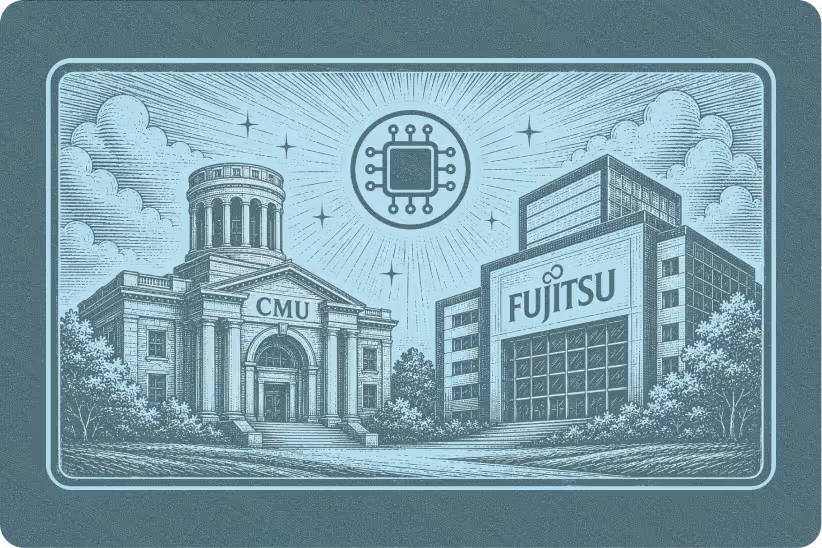
Artificial intelligence is moving beyond servers and screens. Carnegie Mellon University (CMU) and Fujitsu, a top Japanese IT provider, have partnered on an AI research center to revolutionize how machines interact with the physical world.
The Fujitsu-Carnegie Mellon Physical AI Research Center is devoted to creating AI-powered machines and robots that tackle critical issues like labor shortages and workplace safety. This groundbreaking partnership is a major leap toward bringing innovative physical AI solutions to real-world challenges.
This partnership demonstrates how embedding intelligence into real-world machines—and working together—drives true innovation across industries.
Bringing AI into the Physical World
Physical AI puts intelligence directly into robots and autonomous systems, allowing them to act, interact, and make decisions in the real world instead of just processing data behind screens.
With physical AI, machines can sense, decide, and act in real environments—handling obstacles and delicate tasks while making decisions on the spot. They move beyond computation to direct participation in the world.
Interest in physical AI is rapidly growing as experts turn to robotics and machine learning for practical solutions. The Fujitsu-CMU Center is the hub where these ideas become real-world innovations.
A State-of-the-Art Testing Ground
The research center is based at CMU’s advanced Robotics Innovation Center in Pittsburgh, offering top facilities for developing and testing physical AI systems.
The 150,000-square-foot facility equips researchers to rigorously develop and test physical AI systems, ensuring these machines are safe, reliable, and ready for real-world impact.
Solving the Global Labor Crisis
Global labor shortages are putting pressure on industries everywhere. Physical AI offers a real solution by enabling robots to handle repetitive or dangerous tasks, increasing productivity and safety while allowing people to focus on higher-value work.
Physical AI enables companies to boost productivity by deploying robots for repetitive or hazardous tasks, improving efficiency and workplace safety.
Physical AI empowers workers by handling tough, repetitive tasks. This lets people focus on safer, strategic roles and boosts overall efficiency.
Transforming Manufacturing and Logistics
Physical AI boosts manufacturing and logistics by helping robots quickly handle complex tasks like navigating warehouses, assembling parts, and managing inventory. This leads to faster, more reliable deliveries and efficient operations.
Unlike traditional robots, AI-powered machines quickly adapt to unexpected obstacles and changing environments.
These smart systems streamline tasks like loading, assembly, and inventory, making supply chains faster and more reliable.
Advancing Construction, Infrastructure, and Healthcare
Physical AI is revolutionizing construction, infrastructure, and healthcare by empowering robots to handle complex tasks, enhance safety, and support staff in critical roles.
In construction and infrastructure, robots handle heavy lifting, precise tasks, and structural inspections, improving safety and speeding up projects while preventing failures.
Physical AI also addresses healthcare staffing shortages by helping with patient transport, room cleaning, and supply management, allowing medical professionals to focus more on patient care.
The Power of Academic and Industry Partnerships
The Fujitsu-Carnegie Mellon Physical AI Research Center proves that major breakthroughs happen through strong academic and industry partnerships—achieving what neither could do alone.
Fujitsu brings deep IT expertise, while CMU leads in robotics, engineering, and AI research.
By combining CMU’s research innovation with Fujitsu’s industry know-how, this partnership rapidly turns groundbreaking AI and robotics ideas into real-world solutions that deliver real value.
Breaking Down Disciplinary Silos
Effective physical AI requires cross-disciplinary teamwork, combining expertise in engineering, robotics, language technologies, and ethics to tackle complex challenges.
Center experts in robotics, engineering, language technology, and ethics collaborate closely to ensure every physical AI system is advanced, safe, and reliable.
Why Collaboration and Standardization Matter
Physical AI still faces hurdles, like supply chain gaps and lack of standardization that keep robots and systems disconnected.
Without common standards and collaboration, physical AI systems stay isolated and can't scale across industries. The Fujitsu-CMU partnership is crucial for connecting these systems and enabling widespread adoption.
The Fujitsu-CMU partnership is driving physical AI forward by establishing standards and encouraging collaboration, making it easier for businesses to adopt and integrate smart machines across industries.
Building on a Legacy of AI Innovation
CMU advances AI by partnering with industry leaders to drive innovative research and real-world impact.
CMU’s recent collaboration with Bank of New York Mellon created a major AI Lab, while the university’s Learnvia platform now supports AI-driven learning at colleges nationwide.
Martial Hebert, dean of CMU’s School of Computer Science, says the new center strengthens CMU’s commitment to solving real-world problems through industry partnerships, ensuring innovations reach those who need them most.
Partner with FirstIgnite to Build the Future
The Fujitsu-Carnegie Mellon Physical AI Research Center proves that real progress comes from strong partnerships between industry and leading universities.
Partnering with leading institutions unlocks innovative AI and robotics solutions for your toughest business challenges.
Let FirstIgnite connect you with top academic partners to drive innovation and strategic growth.
Contact FirstIgnite to explore partnerships and accelerate innovation for your business.

.avif)
University
March 8, 2023
•
xx
MIN READ
FirstIgnite is supporting the commercialization of Florida International University’s new fabric phase sorptive extraction (FPSE) media technology. This media is used for analyzing trace and ultra-trace levels of organic analytes in various sample matrices. Its benefits include the ability to sample and prepare analytes without matrix modification or pre-treatment, flexibility for sampling and testing in different environments, specificity for various analytes due to the availability of a wide range of sorbent chemistries, and part per quadrillion (ppq) level sensitivity for both polar and medium polar analytes.
The FPSE media technology has a broad range of applications in different fields, including sampling and sample preparation of analytes with forensics, toxicology, national security, public health, environment, food, bio-analysis, clinical, and pharmaceuticals. The global sample preparation market was worth $7.7 billion in 2022 and is projected to grow to $11.2 billion by 2028.
Florida International University’s FPSE media technology is ready for collaboration (licensing, partnerships, industry feedback, etc.). Is your company the right fit? If you’d be available for a conversation with the Florida International University team, you can schedule a time directly on their team’s calendar here.
University
Collaborate: High-Power Laser Profiler
March 7, 2023
•
xx
MIN READ
FirstIgnite is supporting the commercialization of Johns Hopkins University Applied Physics Laboratory’s new high-power laser profiler technology. This technology uses non-contact radiometry to rapidly measure the distribution of laser power across an incident area, providing high precision, safe operation, and custom software.
This technology has applications in various industries, including laser manufacturing, medical, defense and aerospace, nuclear fusion, and solar power generation. The laser processing market is currently valued at $19.06 billion in 2022 and is projected to reach $38.22 billion by 2030.
Johns Hopkins University Applied Physics Laboratory’s high-power laser profiler technology is ready for collaboration (licensing, partnerships, industry feedback, etc.). Is your company the right fit? If you’d be available for a conversation with the Johns Hopkins University team, you can schedule a time directly on their team’s calendar here.
University
Collaborate: Linker Molecules for Bisconjugation
March 7, 2023
•
xx
MIN READ
FirstIgnite is supporting the commercialization of Johns Hopkins University Applied Physics Laboratory’s linker molecules for bisconjugation technology. This technology involves using a novel linker molecule to connect proteins to supports or small molecules. There are numerous advantages to this technology, including a low cost, 3-step manufacturing process, the ability to work with a wide range of proteins, increased protein activity compared to commercially available linkers, and robustness under acidic conditions. Additionally, this technology is highly effective and does not wash off supports.
With its wide range of applications, this technology has potential in various industries, including affinity chromatography for monoclonal antibody purification, cancer treatments, tumor identification, and paintable proteins. The global cancer therapeutics market is expected to reach $335.06 billion by 2029, up from $166.5 billion in 2021.
Johns Hopkins University Applied Physics Laboratory’s linker molecules for bisconjugation technology is ready for collaboration (licensing, partnerships, industry feedback, etc.). Is your company the right fit? If you’d be available for a conversation with the Johns Hopkins University team, you can schedule a time directly on their team’s calendar here.
University
Collaborate: Biomolecular Recognition Analysis Facility
March 6, 2023
•
xx
MIN READ
Drexel University has partnered with FirstIgnite to find industry collaboration for their Biomolecular Recognition Analysis Facility. This facility provides access to state-of-the-art surface plasmon resonance (SPR) technology and testing, as well as expert analysis to support research and development needs. With this research center and testing/analytic facility, fundamental productivity enhancements and translational biomedical research in areas such as cancer and cancer-related diseases, infectious diseases, and biomaterials for tissue regeneration, are all possible.
The Biomolecular Recognition Analysis Facility offers a range of application areas, including protein complex formation mechanisms in pathogenesis and treatment, structure-based design of therapeutics, compound and antibody screening for drug discovery, identification of peptide and small molecule inhibitors, vaccine development and efficacy tracking, integral membrane protein interaction mechanisms, and customized assay design, data analysis, and training.
The Drexel team is seeking collaboration with companies that are interested in utilizing their advanced facilities and leveraging their research capabilities, as well as analytical expertise and services. If your company is interested in exploring a partnership or using their services, you can schedule a conversation with the Drexel University team directly through their team's calendar here.
University
Collaborate: Device for Visual Impairment
March 3, 2023
•
xx
MIN READ
FirstIgnite is supporting the commercialization of Florida International University’s new device for assisting visually impaired patients. By utilizing the remaining functional areas of the retina in individuals with age-related macular degeneration (AMD) and glaucoma, this technology allows patients to visualize complete images of the world, similar to what a normal eye would perceive. This technology is flexible, as it can be reprogrammed to adapt to the progression of AMD and glaucoma, even as these conditions affect larger portions of a patient's visual field. With a period of training, patients can even distinguish between the central and peripheral parts of projected images.
This technology aims to improve the vision of individuals with impaired central and peripheral vision, such as AMD and glaucoma patients. Additionally, it is applicable to the military and defense sectors. Valued at $10.52 billion in 2022, the global age-related macular degeneration market is projected to grow to $17.99 billion by 2030
Florida International University’s new device for assisting visually impaired patients is ready for collaboration (licensing, partnerships, industry feedback, etc.). Is your company the right fit? If you’d be available for a conversation with the Florida International University team, you can schedule a time directly on their team’s calendar here.
University
Collaborate: Sternotomy Patch & Saw Guide
March 3, 2023
•
xx
MIN READ
FirstIgnite is supporting the commercialization of Drexel University’s new sternotomy patch & saw guide technology. This medical device concept is designed to provide cardioprotective patches and saw guides that enable faster, easier, and safer re-sternotomies. As a result, doctors can reduce difficulties and complications of future procedures for patients who require chest surgeries over their lifetime. Clinician-inspired and developed, this novel approach reduces the risk of organ or vessel damage and lowers the likelihood of blood transfusions during re-sternotomies. The firm yet flexible “butterfly” design of the device allows for better protection and surgical guidance, while easy anchoring ensures the patch stays in place over time.
This technology has applications in the medical field, including adult patients with acquired heart conditions who may require multiple surgeries over their lifetime, as well as adult and pediatric patients with congenital heart defects. The technology is particularly useful for assessing scar tissue formation between the sternum and heart more quickly and easily in repeat open chest surgery. Additionally, the technology can be applied to surgical saw accessories, surgical and orthopedic saws, and orthopedic cast improvements. In 2020, the global cardiac surgical devices market was valued at $2.2 billion and is projected to reach $3.1 billion by 2030.
Drexel University’s new sternotomy patch & saw guide technology is ready for collaboration (licensing, partnerships, industry feedback, etc.). Is your company the right fit? If you’d be available for a conversation with the Drexel University team, you can schedule a time directly on their team’s calendar here.
University
Collaborate: MRI Liner
March 3, 2023
•
xx
MIN READ
FirstIgnite is supporting the commercialization of the University of Alberta’s new metamaterial liner for MRI excitation technology. This liner has improved receive sensitivity with fewer elements needed compared to a conventional loop array. The technology offers several benefits, including increased resolution for crisper images, reduced time for patients spent in the MRI machine, decreased claustrophobia, improved signal-to-noise ratio in images, and increased homogeneity.
This technology has applications in the field of magnetic resonance imaging equipment and resources. The global MRI equipment market is projected to experience substantial growth, with an increase from $7.12 billion in 2022 to $11.03 billion by 2029.
The University of Alberta’s MRI liner technology is ready for collaboration (licensing, partnerships, industry feedback, etc.). Is your company the right fit? If you’d be available for a conversation with the University of Alberta team, you can schedule a time directly on their team’s calendar here.
Blogs
New Horizons
New Horizons: Digital Health and Wellness
March 1, 2023
•
xx
MIN READ
The health and wellness market includes various sectors, including personal care, nutrition, physical activity, and preventative and personalized medicine. The demand for health and wellness products is on the rise, with an increasing number of consumers seeking them out. Roughly 50 percent of US consumers now consider wellness a top priority in their daily lives. This trend is further fueled by technological advancements like the Apple Watch and Fitbit, which are driving growth in this category. As of 2022, the global health and wellness market was valued at 4,886.70 billion and is expected to reach 7,656.7 billion by 2030.

Numerous companies operate in the health and wellness sector. Among the top players are L'Oréal ($38.199 billion dollar revenue as of 2021), Unilever ($63.293 billion dollar revenue as of 2022), and Bayer ($53.41 billion dollar revenue as of 2022).
The wellness technology sector, comprising wellness software, tools, and systems, is experiencing increasing investment in venture capital. In 2020, wellness tech startups received $11.4 billion in funding, which grew to $31.7 billion in 2021.
As health and wellness companies continue to grow in revenue and funding, it becomes crucial for universities to establish innovation partnerships with them to stay ahead. FirstIgnite can help your university identify and partner with the health and wellness companies you need to further your research and development.
Groundbreaking University Innovations
University Innovation: How Restasis Transformed Dry Eye
March 1, 2023
•
xx
MIN READ
Did you know that a professor at the University of Georgia invented Restasis? Dr. Renee Kaswan invented the topical eye treatment that improved the lives of those with dry eye syndrome.
Dry eye disease is a condition that occurs when tears are unable to lubricate the eyes adequately, causing discomfort and irritation. Before Restasis, there were no FDA-approved prescription treatments available for this condition. In 1994, Dr. Kaswan, then a professor at the University of Georgia, developed a topical treatment for dry eye in dogs called Optimmune. Following successful human trials, the medication was approved by the FDA in 2002 and sold by Allergan as Restasis. The invention of Restasis, which increases tear production, has significantly improved the lives of the estimated 16 million people in the U.S. living with dry eye syndrome.

The dry eye syndrome treatment market is on the rise, driven by the growing prevalence of the condition. In 2022, the global market size for dry eye syndrome treatment was $5.53 billion, and it is predicted to reach $10.13 billion by 2030. Restasis currently holds the largest market share in this category, accounting for 25% of sales.
Through their research and development efforts, universities have paved the way for significant breakthroughs. Keeping up with university innovation is crucial to your organization’s competitiveness as it allows you to identify new technologies that can help to give you a competitive edge in the market. FirstIgnite can help your organization identify and partner with the specific universities, laboratories, and experts you need in order to discover the next medical innovation like Restasis.
University
Collaborate: Peptide Identification
February 27, 2023
•
xx
MIN READ
FirstIgnite is supporting the commercialization of Florida International University’s new peptide identification system. This system is a distributed design strategy to speed up database peptide search workflows in high-performance computing (HPC) environments. This system enables ultra-fast peptide identification experiments at an extreme scale, and its design model can be easily integrated into existing tools and workflows. By expediting analysis and research, this strategy offers significant benefits for researchers.
This system is applicable to mass spectrometry, proteomics, personal or precision healthcare, and commercial healthcare. The market size for proteomics is expected to experience significant growth in the coming years. In 2021, it was valued at $25.20 billion, and it is projected to reach $100.17 billion by 2030.
Florida International University’s peptide identification system is ready for collaboration (licensing, partnerships, industry feedback, etc.). Is your company the right fit? If you’d be available for a conversation with the Florida International University team, you can schedule a time directly on their team’s calendar here.
Groundbreaking University Innovations
When University Innovation Changed the World: FM Synthesis
February 24, 2023
•
xx
MIN READ
Did you know that a researcher and composer at Stanford University discovered frequency modulation (FM) synthesis? Dr. John Chowning developed the sound technology that is commonly used today.
Before the development of FM synthesis, the main technology used for sound synthesis was AM synthesis. While AM synthesis is still used today, its sound quality is often poor and susceptible to interference due to the limitations of the technology. In 1967, while working at Stanford University, Dr. Chowning discovered FM synthesis while exploring ways to create sounds that were different from those produced by analog synthesis. FM synthesis has the ability to efficiently create a wide range of clear sounds, including bell timbres, metallic tones, tine tones of electric pianos, as well as punchy bass and synthetic brass sounds. The FM synthesis patent was licensed to Yamaha ($3.34 billion in revenue in 2022) by Stanford University in 1973. This patent led to the development of various FM synthesizers for music production. As a result of this partnership between Stanford University and Yamaha, FM synthesis emerged as a widely used sound synthesis method.
FM synthesis technology is currently widely used in the fields of radio and music production. The FM radio industry is experiencing growth as it is utilized not only by individuals but also by industries such as aerospace and defense. In 2019, the global FM radio market was worth $267.71 billion and is projected to reach $458.09 billion by 2027.
Innovation at universities can lead to significant breakthroughs and change the world. Keeping up with university innovation is crucial to your organization’s competitiveness as it allows you to identify new technologies that can help to give you a competitive edge in the market. FirstIgnite can help your organization identify and partner with the specific universities, laboratories, and experts you need in order to discover the next groundbreaking sound technology, like FM synthesis.
New Horizons
New Horizons: Industrial Automation
February 22, 2023
•
xx
MIN READ
Industrial automation refers to the use of computer software and robotics to control machinery and streamline processes, replacing the need for humans in performing certain functions. With the rapid advancements in technology, this market is experiencing significant growth. In 2021, the global industrial automation market was valued at $196.6 billion, and it is projected to reach $412.8 billion by 2030.
The delivery of industrial automation services is reliant on the leadership of companies in the field. Some of the top companies in this field include ABB ($29.446 billion dollar revenue as of 2022), Emerson Electric ($19.846 billion dollar revenue as of 2022), and Rockwell Automation ($7.76 billion dollar revenue as of 2022).
In addition, venture capital investments continue to be a factor for the growth of industrial automation companies. In the last three years (as of 2022), over $160 billion has been invested in industrial technology.
Moreover, the trend of increasing investment in industrial automation is set to continue, due to advantages it offers such as enhanced productivity, flexibility, and safety. It is expected that within the next five years, automated systems and robotics will account for 25 percent of the capital expenditures of industrial companies.
With industrial automation companies experiencing growth in both revenue and funding, it’s important for universities to establish innovation partnerships with them to stay ahead. FirstIgnite can help your university identify and partner with the industrial automation companies you need to further your research and development.