


RESOURCES
Blogs
Insights, strategies, and updates on research commercialization, university innovation, industry partnerships, and AI-powered prospecting
Connecting Industry & Academia
CMU and Fujitsu Launch Physical AI Research Center
April 27, 2026
•
xx
MIN READ
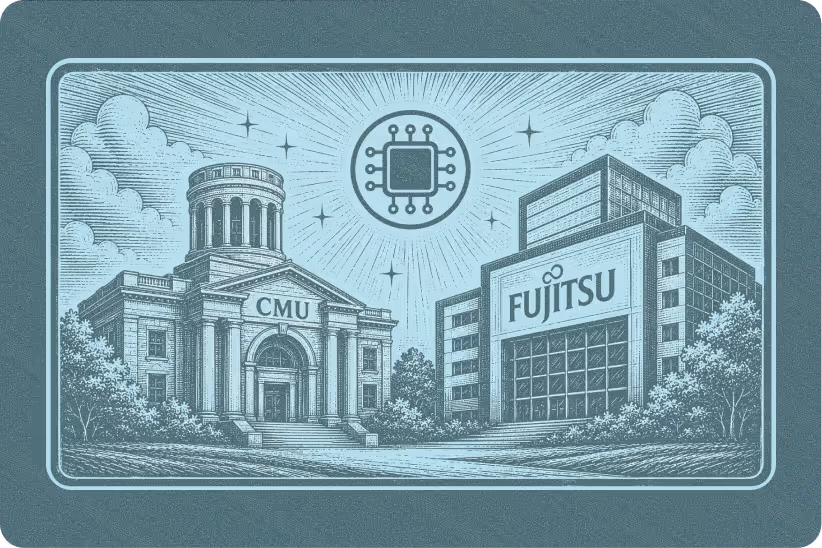
Artificial intelligence is moving beyond servers and screens. Carnegie Mellon University (CMU) and Fujitsu, a top Japanese IT provider, have partnered on an AI research center to revolutionize how machines interact with the physical world.
The Fujitsu-Carnegie Mellon Physical AI Research Center is devoted to creating AI-powered machines and robots that tackle critical issues like labor shortages and workplace safety. This groundbreaking partnership is a major leap toward bringing innovative physical AI solutions to real-world challenges.
This partnership demonstrates how embedding intelligence into real-world machines—and working together—drives true innovation across industries.
Bringing AI into the Physical World
Physical AI puts intelligence directly into robots and autonomous systems, allowing them to act, interact, and make decisions in the real world instead of just processing data behind screens.
With physical AI, machines can sense, decide, and act in real environments—handling obstacles and delicate tasks while making decisions on the spot. They move beyond computation to direct participation in the world.
Interest in physical AI is rapidly growing as experts turn to robotics and machine learning for practical solutions. The Fujitsu-CMU Center is the hub where these ideas become real-world innovations.
A State-of-the-Art Testing Ground
The research center is based at CMU’s advanced Robotics Innovation Center in Pittsburgh, offering top facilities for developing and testing physical AI systems.
The 150,000-square-foot facility equips researchers to rigorously develop and test physical AI systems, ensuring these machines are safe, reliable, and ready for real-world impact.
Solving the Global Labor Crisis
Global labor shortages are putting pressure on industries everywhere. Physical AI offers a real solution by enabling robots to handle repetitive or dangerous tasks, increasing productivity and safety while allowing people to focus on higher-value work.
Physical AI enables companies to boost productivity by deploying robots for repetitive or hazardous tasks, improving efficiency and workplace safety.
Physical AI empowers workers by handling tough, repetitive tasks. This lets people focus on safer, strategic roles and boosts overall efficiency.
Transforming Manufacturing and Logistics
Physical AI boosts manufacturing and logistics by helping robots quickly handle complex tasks like navigating warehouses, assembling parts, and managing inventory. This leads to faster, more reliable deliveries and efficient operations.
Unlike traditional robots, AI-powered machines quickly adapt to unexpected obstacles and changing environments.
These smart systems streamline tasks like loading, assembly, and inventory, making supply chains faster and more reliable.
Advancing Construction, Infrastructure, and Healthcare
Physical AI is revolutionizing construction, infrastructure, and healthcare by empowering robots to handle complex tasks, enhance safety, and support staff in critical roles.
In construction and infrastructure, robots handle heavy lifting, precise tasks, and structural inspections, improving safety and speeding up projects while preventing failures.
Physical AI also addresses healthcare staffing shortages by helping with patient transport, room cleaning, and supply management, allowing medical professionals to focus more on patient care.
The Power of Academic and Industry Partnerships
The Fujitsu-Carnegie Mellon Physical AI Research Center proves that major breakthroughs happen through strong academic and industry partnerships—achieving what neither could do alone.
Fujitsu brings deep IT expertise, while CMU leads in robotics, engineering, and AI research.
By combining CMU’s research innovation with Fujitsu’s industry know-how, this partnership rapidly turns groundbreaking AI and robotics ideas into real-world solutions that deliver real value.
Breaking Down Disciplinary Silos
Effective physical AI requires cross-disciplinary teamwork, combining expertise in engineering, robotics, language technologies, and ethics to tackle complex challenges.
Center experts in robotics, engineering, language technology, and ethics collaborate closely to ensure every physical AI system is advanced, safe, and reliable.
Why Collaboration and Standardization Matter
Physical AI still faces hurdles, like supply chain gaps and lack of standardization that keep robots and systems disconnected.
Without common standards and collaboration, physical AI systems stay isolated and can't scale across industries. The Fujitsu-CMU partnership is crucial for connecting these systems and enabling widespread adoption.
The Fujitsu-CMU partnership is driving physical AI forward by establishing standards and encouraging collaboration, making it easier for businesses to adopt and integrate smart machines across industries.
Building on a Legacy of AI Innovation
CMU advances AI by partnering with industry leaders to drive innovative research and real-world impact.
CMU’s recent collaboration with Bank of New York Mellon created a major AI Lab, while the university’s Learnvia platform now supports AI-driven learning at colleges nationwide.
Martial Hebert, dean of CMU’s School of Computer Science, says the new center strengthens CMU’s commitment to solving real-world problems through industry partnerships, ensuring innovations reach those who need them most.
Partner with FirstIgnite to Build the Future
The Fujitsu-Carnegie Mellon Physical AI Research Center proves that real progress comes from strong partnerships between industry and leading universities.
Partnering with leading institutions unlocks innovative AI and robotics solutions for your toughest business challenges.
Let FirstIgnite connect you with top academic partners to drive innovation and strategic growth.
Contact FirstIgnite to explore partnerships and accelerate innovation for your business.

.avif)
No items found.
November 9, 2022
•
xx
MIN READ
Did you know that University of Toronto scientists discovered insulin to treat diabetes? Dr. Frederick G Banting, Dr. J.J.R. Macleod, Dr. Charles Best, and Dr. James B. Collip developed the hormone that has saved many people’s lives.Patients with type 1 diabetes had an expected lifespan of fewer than three years before the discovery of insulin. The only treatment option was a diet low in carbohydrates, which proved futile for effective treatment.Scientists had done previous research which showed that the hormone insulin is missing in the pancreas of people with diabetes. In 1921, Dr. Banting, Dr. Mcleod, and Dr. Best, while working at the University of Toronto, extracted insulin from a dog's pancreas and used it to treat another dog with diabetes successfully. Then, Dr. Collip joined the team and was able to purify insulin from cattle, making it safe for human use. In 1922, this purified form of insulin was used to treat a diabetic patient, saving his life.After this achievement, insulin was produced on a large scale. In 1923, Eli Lilly and Company, which has a revenue of $28.31 billion dollars today, was the first insulin producer, and continues to manufacture the treatment today. Since its initial production, there has been consistent growth in the insulin market, which is expected to reach $23.57 billion dollars by 2030. The medication that has saved many lives since its inception continues to have a lasting impact on those with diabetes. Currently, over 7 million people in the U.S. use insulin daily.

University innovation has the ability to save lives. It's important to have a strategy in place to ensure your organization has an active eye on innovations being born on campuses around the globe. FirstIgnite can help your organization identify and partner with the specific universities, laboratories, and experts you need in order to create the next miracle treatment, like insulin.
No items found.
New Horizons: Growth of Cybersecurity Market
November 4, 2022
•
xx
MIN READ
Is your campus ready for the Cyber Security boom? This article provides an overview of the cyber security industry and its growth, underscoring the importance of being a first mover in establishing partnerships with cyber security companies. We aim to help your campus understand the market opportunities in the global cyber security market and the potential for growth partnerships in the cyber security sector.Cybersecurity, a key aspect of the information security industry, involves the protection of computer systems and networks from unauthorized use of hardware, software, or electronic data. This defense cybersecurity sector, which began in the 1970s when an engineer named Bob Thomas developed an antivirus program named Reaper, has grown into a significant IT security industry. Cybersecurity has come a long way since then, with the market being worth $223.7 billion in 2023.Companies understand the importance of cybersecurity, with spending in the category being around $300 billion dollars. Spending continues to grow, especially since more and more companies have moved online, and it is expected to reach $458.9 billion dollars in 2025.

With the five main types of cybersecurity - critical infrastructure security, application security, network security, cloud security, and internet of things (IoT) security, the cybersecurity industry has seen significant growth. The cybersecurity market size is dominated by top companies like Palo Alto Networks ($6.893 billion dollar revenue), Fortinet ($4.417 Billion dollar revenue), and Crowdstrike ($2.241 Billion dollar revenue), reflecting the cyber security industry growth and the increasing cyber security market share. Additionally, over $20 billion dollars in venture capital was invested in 750+ cybersecurity startups in 2021.Companies understand the importance of cybersecurity, with spending in the category expected to reach $215 billion in 2024. Security services makes up the largest segment in this category, with spending expected to reach $90 billion in 2024.At this time, there are over 9,000 cybersecurity companies in the US. This is 9,000 unique opportunities for your campus to reach out and form a partnership for sponsored research, experiential learning, licensing, and more. FirstIgnite can help your university become a market leader in cyber security through enhancing your marketing efforts.
No items found.
Collaborate: Industry Partners
November 1, 2022
•
xx
MIN READ
James Madison University has partnered with FirstIgnite to find industry partners for collaboration opportunities for their College of Integrated Science and Engineering (CISE). A community of insightful and adaptable problem-solvers, the CISE is looking for collaborations regarding student recruitment, corporate information sessions, and speaker sessions.By combining computer science, engineering, and integrated sciences, the CISE has created a unique education environment emphasizing hands-on learning. By joining their partners program, your company can raise its profile, gain brand awareness, convey its corporate values, and connect with a pool of talented future employees.The CISE is in the process of establishing new partnerships with companies like yours. Would your company like to be an affiliate? If you are interested in a conversation with the CISE team, reach out to us on our website’s homepage, you can schedule a time directly on their team’s calendar here.
No items found.
Collaborate: Drones & Ceramic Engineering
November 1, 2022
•
xx
MIN READ
The University of Missouri and Southern Illinois University systems have partnered with FirstIgnite to find organizations interested in collaborations with their faculty through their Research Enabled platform. Research Enabled allows companies to present queries to an online portal, which can then be answered by faculty throughout the university systems. Just a few of the participating schools include the University of Missouri, Missouri S&T, Southern Illinois University Carbondale, and the University of Missouri-Saint Louis.In the last ten years, state funding for universities has decreased by $9 billion dollars. Now is the time for universities to seek new private funding sources. By breaking down barriers and providing easy access to thousands of researchers, Research Enabled makes collaboration possible.Currently, Research Enabled is seeking new partnerships with companies like yours. Would your company like to be an affiliate? If you are interested in a conversation with the University of Missouri and Southern Illinois University systems team, you can schedule a time directly on their team’s calendar here.
No items found.
Collaborate: Nyheim Plasma Institute
November 1, 2022
•
xx
MIN READ
Drexel University has partnered with FirstIgnite to find licensing opportunities and collaborative research engagements for their Nyheim Plasma Institute. Since 2002, the Nyheim Plasma Institute has been at the forefront of cold plasma technology research and development. Drexel researchers have developed novel concepts and engineering approaches for leveraging non-thermal plasma technology for industrial applications. This technology is applicable to fuel conversion, fuel desulfurization and cleaning, carbon dioxide sequestration, hydrogen production, and waste to energy conversion. In addition, they have invented processes for plasma-stimulated incorporation of natural gas into liquid fuel. Their core expertise in atmospheric plasma technology is also relevant to emerging needs in agriculture, water treatment, and food processing safety.The cold plasma market was worth $1.6 billion in 2021 and is expected to grow to $2.2 billion by 2026. The cold plasma market continues to grow because of its need in a variety of industries, such as semiconductors, electronics, textiles, medicine, and agriculture.The Nyheim Plasma Institute’s research puts Drexel University at an advantage in this industry, advantages ready to be developed for transition into the marketplace. Is your company the right fit for collaboration? If you are interested in a conversation with the Drexel University team, you can schedule a time directly on their team’s calendar here.
No items found.
Collaborate: Next Generation Data Analytics
November 1, 2022
•
xx
MIN READ
The Tepper School of Business, located at Carnegie Mellon University, is ranked number 5 in undergraduate business programs by the U.S. News & World Report. Furthermore, the Tepper School of Business is an excellent research institution, constructing innovative ideas and generating knowledge that improves society and strengthens business practices. Since 2008, over 400 startups have been formed out of Tepper. With constant innovation happening, the university understands the importance of creating partnerships with industry leaders to provide their students with practical learning opportunities in data analytics.The Tepper School of Business prepares students to be the next generation of leaders in data analytics in an ever-fluid and advancing business world. According to the U.S. News & World Report, their business analytics MBA program is #2 in the United States.The Tepper School of Business team has partnered with FirstIgnite to help identify industry collaboration opportunities in the form of project sponsorships for experiential learning opportunities and capstone projects. This is an opportunity to collaborate with the next generation of data analytics leaders who are being taught cutting-edge approaches to data analysis including machine learning and optimization, data management programs, and utilizing obtained data in decision making. Partnering with students can be very impactful. Experiential learning projects, where a student team tackles a challenge your company is working on, are a great way to source new ideas and talent.FirstIgnite is looking for companies to help accomplish these objectives through collaboration and project sponsorship. Is your company the right fit? If you’d be available for a conversation with the Carnegie Mellon University team, we can coordinate a conversation with the university.
No items found.
When University Innovation Changed the World: DNA Fingerprinting
November 1, 2022
•
xx
MIN READ
Did you know that a University of Leicester geneticist discovered DNA fingerprinting? Dr. Alec Jeffreys developed the technology that transformed the field of forensic science.Before the invention of DNA fingerprinting, scientists were unable to identify people based on fingerprints. Instead, they had to rely on less accurate forms of identifying criminals, such as anthropometric measurements and photos. In 1984, Dr. Jeffreys was experimenting with ways illnesses are inherited through families while working at the University of Leicester. Through his experiment, he accidentally discovered a way to identify specific individuals based on their fingerprints.The first applications of DNA fingerprinting in 1984 were conducted to solve UK immigration cases, with 18,000 cases being solved in that decade. It wasn’t until 1986, when Dr. Jeffreys was contacted by the Leicestershire Police, that DNA fingerprinting would be used to solve a criminal case. Through this method, Dr. Jeffreys was able to prove a man’s innocence in a murder case. The same method was used to catch the true criminal in the case, paving the way for the use of DNA in modern criminal investigations. In 1987, the company Cellmark was founded in the UK as the “first commercial DNA testing laboratory” using Jeffrey’s technology. Today, they have an annual revenue of $21 million dollars and continue to offer DNA testing services for immigration, paternity, alcohol, and forensics. Cellmark has paved the way for other forensic DNA companies in the US, like Bode Technology Group, a company with an annual revenue of $50 million dollars, that conducts forensic DNA testing for criminal investigations. Today, DNA testing is used to solve some of the most difficult cold cases, with one of the most high profile being the Golden State Killer, whose crimes were committed prior to the discovery of DNA fingerprinting.

Innovation is a constant at Universities. It's important to have a strategy in place to ensure your organization has an active eye on innovations being born on campuses around the globe. FirstIgnite can help your organization identify and partner with the specific universities, laboratories, and experts you need in order to discover the next genetic breakthrough, like DNA fingerprinting.
No items found.
Auburn University’s Years Long Relationship with FirstIgnite Continues to Build Success with 15+ New Corporate Connections for Their Technology Portfolio
October 28, 2022
•
xx
MIN READ
The Office of Innovation Advancement and Commercialization (IAC) at Auburn University serves as the link between the commercial marketplace and Auburn University innovations. IAC evaluates and protects Auburn University's intellectual property, seeks licensing agreements with commercial entities, and collaborates to form start-up companies to take Auburn research developments into the marketplace for the public benefit. To affect the success of their entire technology portfolio, the IAC team has partnered with FirstIgnite since 2020 to marketing a wide gamut of technologies within their purview, ensuring important feedback for research direction as well as securing potential licensing candidates.Understanding a technology portfolio’s market applicability is one of the chief challenges facing technology transfer offices. Are faculty members concentrating their research on areas companies will find attractive? Is this technology worthy of entering the patenting process? How can this professor’s theoretical work translate into the real world? These are just a few of questions that technology transfer teams need to consider as they attempt to build corporate relationships. FirstIgnite’s marketing process, which can be successful with any scientific medium, ensures that marketing consistently and across a portfolio will leverage the entirety of a university’s research strengths to build as many long-lasting corporate connections as possible.[caption id="attachment_4792" align="alignnone" width="1078"]

Two technologies within Auburn University's portfolio which they have successfully marketed with FirstIgnite.[/caption]Auburn’s IAC learned this fact throughout their relationship with FirstIgnite. While a 3D printing technology could bring in multiple meetings with interested companies, another might not get the reception from industry needed to continue to justify research investment. Through mixing up and consistently marketing across their portfolio, the IAC was able to find that one of their bio-lubricant technologies had interest from large petroleum companies like Valero, Shell, and Valvoline.During the month of October, that same bio-lubricant technology, along with research related to a crop growth library, brought the IAC team more than 15 companies interested in seeing how licensing and collaborations could be possible. More than the meetings themselves, the individuals coming to the meetings (Executive VPs, Directors of Business Development, and CEOs) have decision making authority to move the conversations forward far past initial introductions.FirstIgnite’s marketing services utilize a proprietary software to be completely technology agnostic. This ensures that across technology portfolios, successful corporate relationships can be found, regardless of the topic. The 120+ conversations booked for technology transfer offices throughout the month of October are just one more indicator to the success of FirstIgnite’s process. Auburn IAC can attest to that since 2020.
No items found.
University Innovation: How Stanford Gave Birth to Google
October 27, 2022
•
xx
MIN READ
Did you know that Stanford University computer scientists created Google? Dr. Larry Page and Dr. Sergey Brin developed the search engine that changed the way we use the internet today.Before the invention of Google, information on the internet was not as easily stored. In 1995, Dr. Page and Dr. Brin, who were Stanford computer science Ph.D. students at the time, set out “to organize the world’s information and make it universally accessible and useful.” Google was different from previous search engines because it ranked web pages based on relevancy to the search and by how many relevant pages linked to it, something that no other search engine did at the time.In 1998, Andy Bechtolsheim, a co-founder of Sun Microsystems, invested in Google, and the web browser was founded that same year. Within the next few years, the company grew at a rapid rate.Today, Google is a company known throughout the world. It is not only a search engine, but also produces physical products, including phones, speakers, and watches. The company has a revenue of $256.74 billion dollars today, and with Google being the most popular search engine, there are about 5.4 billion Google searches per day.

Universities are a hotbed for innovation. It's important to have a strategy in place to ensure your organization has an active eye on innovations being born on campuses around the globe. FirstIgnite can help your organization identify and partner with the specific universities, laboratories, and experts you need in order to create the next monumental software innovation, like Google.
University
Collaborate: Semisynthesis of Arsinothricin
October 25, 2022
•
xx
MIN READ
FirstIgnite is supporting the commercialization of Florida International University’s new technology for the semisynthesis of arsinothricin. The benefits of this technology include that it provides a simple synthesis method of AST-OH and its derivatives, can be scaled up to produce AST and its derivatives in amounts sufficient for further drug development, and it eliminates the necessity of conversion of pentavalent arsenic acids with toxic SO2 gas, and challenging displacement of hydroxyl group with chloride.This technology is applicable to drug development, specifically antibacterial candidates against bacterial species from both Gram-positive and Gram-negative. In 2021, the global drug discovery market was worth $74.96 billion and is expected to reach $161.76 billion by 2030. The technology for the semisynthesis of arsinothricin developed at Florida International University is ready for collaboration, and they are looking for industry feedback on their research and potential future collaboration (licensing, partnerships, industry feedback, etc.). Is your company the right fit? If you’d be available for a conversation with the Florida International University team, you can schedule a time directly on their team’s calendar here.
No items found.
Collaborate: Oxidation of Hydrocarbons
October 25, 2022
•
xx
MIN READ
FirstIgnite is supporting the commercialization of Florida International University’s new technology for copper catalysts which oxidize hydrocarbons. This technology is cost-effective and sustainable, catalysts use atmospheric oxygen as oxidant and are easy to prepare, ligands of the complexes are readily available, peripheral ligand substitution can produce catalysts tailored to specific applications, and low-grade hydrocarbons can be used as substrates of the dinuclear copper catalyst.As of 2022, the global petrochemicals market is worth $584.50 billion and is expected to reach $1,002.45 billion by 2030. There is increasing demand for petrochemical products because they are a vital component for many industrial processes.The technology for copper catalysts which oxidize hydrocarbons developed at Florida International University is ready for collaboration, and they are looking for industry feedback on their research and potential future collaboration (licensing, partnerships, industry feedback, etc.). Is your company the right fit? If you’d be available for a conversation with the Florida International University team, you can schedule a time directly on their team’s calendar here.
No items found.
Collaborate: Characterization of Ultra-Soft Materials
October 25, 2022
•
xx
MIN READ
FirstIgnite is supporting the commercialization of Florida International University’s new system for testing mechanical properties of an ultra-soft material in the meso/macro-length scale. This system allows for the measurement of bulk mechanical properties of centimeter-scale ultra-soft materials through the indentation technique, allows for mechanical property testing of ultra-soft materials, is adaptable for conventional table-top mechanical frames, and can be implemented at a minimal cost.Of the many fields this system is applicable to, the tissue engineering market is on the rise. As of 2021, the tissue engineering market was worth $12.76 billion and is expected to reach $31.23 billion by 2030.Florida International University’s system for testing mechanical properties of an ultra-soft material in the meso/macro-length scale is ready for collaboration, and they are looking for industry feedback on their research and potential future collaboration (licensing, partnerships, etc.). Is your company the right fit? If you’d be available for a conversation with the Florida International University team, you can schedule a time directly on their team’s calendar here.