


RESOURCES
Blogs
Insights, strategies, and updates on research commercialization, university innovation, industry partnerships, and AI-powered prospecting
Connecting Industry & Academia
CMU and Fujitsu Launch Physical AI Research Center
April 27, 2026
•
xx
MIN READ
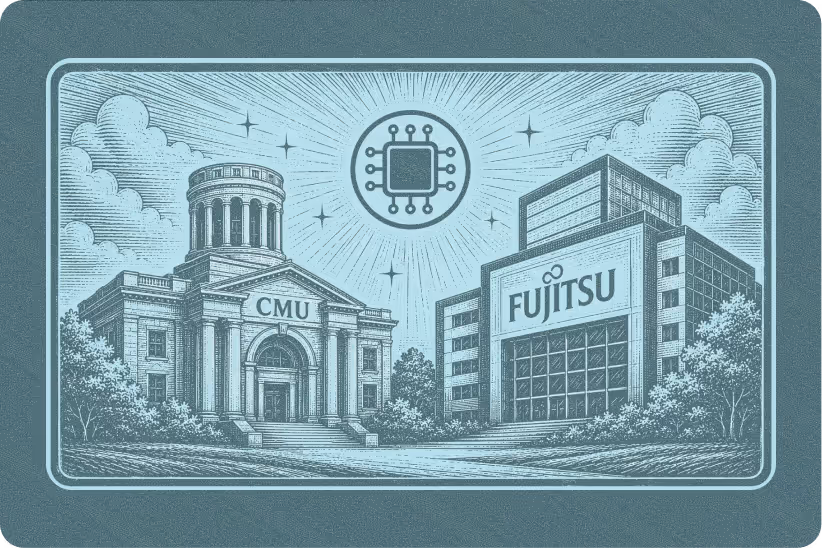
Artificial intelligence is moving beyond servers and screens. Carnegie Mellon University (CMU) and Fujitsu, a top Japanese IT provider, have partnered on an AI research center to revolutionize how machines interact with the physical world.
The Fujitsu-Carnegie Mellon Physical AI Research Center is devoted to creating AI-powered machines and robots that tackle critical issues like labor shortages and workplace safety. This groundbreaking partnership is a major leap toward bringing innovative physical AI solutions to real-world challenges.
This partnership demonstrates how embedding intelligence into real-world machines—and working together—drives true innovation across industries.
Bringing AI into the Physical World
Physical AI puts intelligence directly into robots and autonomous systems, allowing them to act, interact, and make decisions in the real world instead of just processing data behind screens.
With physical AI, machines can sense, decide, and act in real environments—handling obstacles and delicate tasks while making decisions on the spot. They move beyond computation to direct participation in the world.
Interest in physical AI is rapidly growing as experts turn to robotics and machine learning for practical solutions. The Fujitsu-CMU Center is the hub where these ideas become real-world innovations.
A State-of-the-Art Testing Ground
The research center is based at CMU’s advanced Robotics Innovation Center in Pittsburgh, offering top facilities for developing and testing physical AI systems.
The 150,000-square-foot facility equips researchers to rigorously develop and test physical AI systems, ensuring these machines are safe, reliable, and ready for real-world impact.
Solving the Global Labor Crisis
Global labor shortages are putting pressure on industries everywhere. Physical AI offers a real solution by enabling robots to handle repetitive or dangerous tasks, increasing productivity and safety while allowing people to focus on higher-value work.
Physical AI enables companies to boost productivity by deploying robots for repetitive or hazardous tasks, improving efficiency and workplace safety.
Physical AI empowers workers by handling tough, repetitive tasks. This lets people focus on safer, strategic roles and boosts overall efficiency.
Transforming Manufacturing and Logistics
Physical AI boosts manufacturing and logistics by helping robots quickly handle complex tasks like navigating warehouses, assembling parts, and managing inventory. This leads to faster, more reliable deliveries and efficient operations.
Unlike traditional robots, AI-powered machines quickly adapt to unexpected obstacles and changing environments.
These smart systems streamline tasks like loading, assembly, and inventory, making supply chains faster and more reliable.
Advancing Construction, Infrastructure, and Healthcare
Physical AI is revolutionizing construction, infrastructure, and healthcare by empowering robots to handle complex tasks, enhance safety, and support staff in critical roles.
In construction and infrastructure, robots handle heavy lifting, precise tasks, and structural inspections, improving safety and speeding up projects while preventing failures.
Physical AI also addresses healthcare staffing shortages by helping with patient transport, room cleaning, and supply management, allowing medical professionals to focus more on patient care.
The Power of Academic and Industry Partnerships
The Fujitsu-Carnegie Mellon Physical AI Research Center proves that major breakthroughs happen through strong academic and industry partnerships—achieving what neither could do alone.
Fujitsu brings deep IT expertise, while CMU leads in robotics, engineering, and AI research.
By combining CMU’s research innovation with Fujitsu’s industry know-how, this partnership rapidly turns groundbreaking AI and robotics ideas into real-world solutions that deliver real value.
Breaking Down Disciplinary Silos
Effective physical AI requires cross-disciplinary teamwork, combining expertise in engineering, robotics, language technologies, and ethics to tackle complex challenges.
Center experts in robotics, engineering, language technology, and ethics collaborate closely to ensure every physical AI system is advanced, safe, and reliable.
Why Collaboration and Standardization Matter
Physical AI still faces hurdles, like supply chain gaps and lack of standardization that keep robots and systems disconnected.
Without common standards and collaboration, physical AI systems stay isolated and can't scale across industries. The Fujitsu-CMU partnership is crucial for connecting these systems and enabling widespread adoption.
The Fujitsu-CMU partnership is driving physical AI forward by establishing standards and encouraging collaboration, making it easier for businesses to adopt and integrate smart machines across industries.
Building on a Legacy of AI Innovation
CMU advances AI by partnering with industry leaders to drive innovative research and real-world impact.
CMU’s recent collaboration with Bank of New York Mellon created a major AI Lab, while the university’s Learnvia platform now supports AI-driven learning at colleges nationwide.
Martial Hebert, dean of CMU’s School of Computer Science, says the new center strengthens CMU’s commitment to solving real-world problems through industry partnerships, ensuring innovations reach those who need them most.
Partner with FirstIgnite to Build the Future
The Fujitsu-Carnegie Mellon Physical AI Research Center proves that real progress comes from strong partnerships between industry and leading universities.
Partnering with leading institutions unlocks innovative AI and robotics solutions for your toughest business challenges.
Let FirstIgnite connect you with top academic partners to drive innovation and strategic growth.
Contact FirstIgnite to explore partnerships and accelerate innovation for your business.

.avif)
Groundbreaking University Innovations
December 6, 2022
•
xx
MIN READ
Did you know that two university engineers invented the first spreadsheet? Dan Bricklin and Bob Frankston developed the computer program that changed the way we organize data.
Prior to the invention of spreadsheets, data was organized, analyzed, and manipulated by hand. This method took more time and accounted for more errors. In 1979, Bricklin, while obtaining his master’s degree from Harvard University, and Frankston developed the first spreadsheet. Bricklin and Frankston had previously worked together at MIT and used a rented computer at the university to create the spreadsheet. They called this program VisiCalc, and it was programmed for the Apple II computer. The program was a success and marked the beginning of businesses purchasing the Apple II for the software. The two inventors established an entire category with the invention of VisiCalc, an impressive achievement born out of university innovation.

After the invention of VisiCalc, many more advanced spreadsheet programs surfaced, such as the program from the company Consumers Software, which was acquired by Microsoft and is the basis for Microsoft Excel. Today, Microsoft Excel is the top spreadsheet software, which has 1.1 billion users. VisiCalc paved the way for this program which is now considered essential for many businesses. As of 2022, the U.S. office software market is worth $24.7 billion dollars and is expected to reach $37.4 billion dollars by 2028. The spreadsheet software market captured the largest market share in this category.
University innovation has the ability to change the world. Your organization needs to be aware of innovations emerging on campuses all over the world in order to remain competitive. FirstIgnite can help your organization identify and partner with the specific universities, laboratories, and experts you need in order to discover the next technological breakthrough, like the spreadsheet.
New Horizons
New Horizons: Data Analytics
December 2, 2022
•
xx
MIN READ
Data analytics is the science of analyzing raw data and drawing conclusions from that data. Despite the fact that data science isn't a new industry, it has developed considerably over the last few decades as technology has advanced. As of 2021, the data analytics market is worth $240.6 billion dollars and is expected to reach $655.53 billion dollars by 2029.The four main types of data analysis are predictive, descriptive, prescriptive, and diagnostic, which is why data analytics companies are essential. Currently, some of the top data analytics companies include Accenture ($61.594 billion dollar revenue), Oracle ($42.44 billion dollar revenue), and Tableau ($1.2 billion dollar revenue). In addition, healthcare data analytics companies alone raised $1.8 billion in venture capital funding in 2020.Some of the benefits of data analytics include improved efficiency, enhanced customer experience, and more effective decision-making. Thus, companies understand the importance of data analytics, with spending in the category being around $187 billion dollars.The number of data analytics companies has risen to more than 7,000, so now is a great time to connect with them. FirstIgnite can help your university identify and partner with the specific companies you need to further your research and development in cybersecurity.
University
Collaborate: Metal Sulfide Filled Carbon Nanotubes
December 2, 2022
•
xx
MIN READ
FirstIgnite is supporting the commercialization of Florida International University’s new one-step filling process for carbon nanotubes. The benefits of this process include that it can be scaled up, yields high purity filled carbon nanotubes (CNTs), can encapsulate metal-sulfide nanowires of up to 30 micrometers or more in length, the filling rate and ratio, as well as the length and average diameter can be controlled, the CNTs are directly grown on the carbon-based substrate, no glue or binder are needed, and the CNTs have excellent lithium storage capability.This technology is applicable to lithium-ion batteries (LIBs), sodium-ion batteries (SIBS), and nano breakers for electronic devices. As of 2022, the global lithium-ion battery market is worth $48.19 billion and is expected to reach $182.53 billion by 2030. Florida International University's one-step filling process for carbon nanotubes is ready for collaboration, and they are looking for industry feedback on their research and potential future collaboration (licensing, partnerships, industry feedback, etc.). Is your company the right fit? If you’d be available for a conversation with the Florida International University team, you can schedule a time directly on their team’s calendar here.
University
Collaborate: Dinuclear Silver(I) Pyrazolates
December 2, 2022
•
xx
MIN READ
FirstIgnite is supporting the commercialization of Florida International University’s new technology involving silver complexes to treat infections. This technology is effective against drug resistant bacterial strains, attenuates infection without the creation of resistant bacteria or adverse effects, and provides slow release of bioactive silver.This technology is applicable to creams/patches/bandages to treat burn wounds and other skin infections, the treatment and prevention of infections caused by multidrug resistant Gram-positive, Gram-negative, fungal, and viral infections, and surface treatment of surgical instruments, medical and healthcare devices, and food processing. As of 2022, the global burn care market is worth $2.4 billion and is expected to grow to $4.2 billion by 2030.Florida International University’s new technology involving silver complexes to treat infections is ready for commercialization, and they are looking for industry feedback on their research and potential future collaboration (licensing, partnerships, industry feedback, etc.). Is your company the right fit? If you’d be available for a conversation with the Florida International University team, you can schedule a time directly on their team’s calendar here.
University
Collaborate: Life Sciences Institute
December 2, 2022
•
xx
MIN READ
The University of Michigan’s Life Sciences Institute (LSI) has partnered with FirstIgnite to find industry collaboration for their Natural Products Discovery Core. The Natural Products Discovery Core holds an extensive library of 45,000 (and growing) natural product extracts derived from diverse marine and terrestrial actinomycetes, fungi, and cyanobacteria.Through the core, researchers at U-M and external partners can develop unique, bioactive, patentable small molecules from candidates identified through high-throughput screening. Some of the core’s research projects include natural product discovery to identify inhibitors of eIF4E, discovering novel therapeutics for treating fibrotic disease, and the discovery of STING agonists for cancer immunotherapy. Research conducted by the LSI gives the University of Michigan a competitive advantage. Would your company like to be an affiliate? If you are interested in a conversation with the University of Michigan LSI team, you can schedule a time directly on their team’s calendar here.
Groundbreaking University Innovations
When University Innovation Changed the World: Artificial Heart Valve
November 30, 2022
•
xx
MIN READ
Did you know that a Georgetown University surgeon invented the first artificial heart valve? Dr. Charles Hufnagel created the device that has saved many lives.Prior to the invention of artificial heart valves, there was no way to replace heart valves that did not work properly. In 1952, while working at Georgetown, Hufnagel developed the first artificial heart valve. This first prosthetic valve was successfully used in patients, which is especially important because it was the first functional artificial body part that was able to move. This invention paved the way for prosthetic body parts.As of 2021, the prosthetic heart valve market in North America is worth $6.6 billion dollars, and is expected to reach $13.3 billion dollars by 2028. This growth is attributed to an increasing number of people needing prosthetic heart valves to replace heart valves that have become impaired with age or by certain diseases or congenital abnormalities. Currently, the United States alone performs over 182,000 heart valve replacements each year. That is over 182,000 lives saved due to a Georgetown University innovation.

University innovation has the ability to change the world. To remain competitive, your organization needs to be aware of innovations being born on campuses around the world. FirstIgnite can help your organization identify and partner with the specific universities, laboratories, and experts you need in order to discover the next life-saving device, like the artificial heart valve.
Connecting Industry & Academia
Customer Success
University
How to Partner with FirstIgnite to Grow Industry Engagement for Internal University Tools: Research Enabled at the University of Missouri & Southern Illinois University Systems
November 30, 2022
•
xx
MIN READ
The University of Missouri and Southern Illinois University systems have created and maintain an internal portal call Research Enabled for corporate use to communicate with their faculty and staff. The Research Enabled portal quickly connects companies to the wealth of expertise and resources at the seven campuses of that make up these university systems to address technical, business and other research needs of industry and organizations. The portal is meant to facilitate collaboration by breaking down barriers and providing easy access to thousands of researchers. Faculty expertise and interests are captured on the portal and matched with relevant industry opportunities. With such a multifaceted tool that can be utilized across disciplines between these universities, their teams made the decision to partner with FirstIgnite since the Autumn of 2021 to support a variety of industry initiatives. These activities have ensured that the Research Enabled portal has received interaction from hundreds of companies across a variety of industry fields.Marketing internal tools at universities is a difficult problem. From their situational usage to lack of available resources to support marketing activities, internal tools are often left behind in the myriad of activities that universities concentrate on when attempting to communicate themselves to a wider audience. FirstIgnite is able to supplement these activities at both a wide berth and with industry specificity, giving even the most idiosyncratic of internal projects and tools the chance to connect with hundreds of interested organizations. With as little as a keyword, FirstIgnite’s natural language processing (NLP) software is able to identify organizations that would be a perfect fit to communicate with for conversations with university staff regarding how collaboration may be possible.[caption id="attachment_4960" align="alignnone" width="1050"]

The Research Enabled platform is the place to go for any kind of faculty collaboration at the university systems of Missouri and Southern Illinois University.[/caption]By working with FirstIgnite in a long-form concentrated effort, the university teams have been able to speak with more than 120 companies regarding Research Enabled since their partnership began at the end of 2021. From areas as diverse as drones (PrecisionHawk) to radiopharmaceuticals (Clarity Pharmaceuticals), introductions made by FirstIgnite have led to Research Enabled’s usage and growth with industry.No matter the corporate engagement initiative, FirstIgnite’s services help to ensure that university teams are top of mind for industry as they consider their next project or collaborative effort. FirstIgnite has been able to build 800+ of these relationships since the beginning of 2022 for more than 65 schools across the United States, Canada, and the UK. It’s no wonder why the University of Missouri and Southern Illinois University systems are continuing to place their trust in FirstIgnite’s processes for Research Enabled’s growth for a third year in a row.
University
Collaborate: Pain Signaling
November 22, 2022
•
xx
MIN READ
FirstIgnite is supporting the commercialization of the University of California Davis’s new technology for the relief of chronic and/or severe pain. The benefits of this technology are the optimization of wild-type ProTx-II peptide selectivity and potency and a non-addictive alternative to opioid analgesics.This technology can be applied to the relief of chronic and/or severe pain in humans. As of 2021, the U.S. pain management therapeutics market is worth $6.75 billion and is expected to reach $12.55 billion by 2028. The University of California Davis’s technology for the relief of chronic and/or severe pain is ready for collaboration, and they are looking for industry feedback on their research and potential future collaboration (licensing, partnerships, industry feedback, etc.). Is your company the right fit? If you’d be available for a conversation with the University of California Davis team, you can schedule a time directly on their team’s calendar here.
No items found.
New Horizons: Remote Patient Monitoring
November 22, 2022
•
xx
MIN READ
The Growing Remote Patient Monitoring Market: A Lucrative Healthcare SectorThe remote patient monitoring market size is witnessing a significant expansion in healthcare, presenting numerous growth opportunities. Do your campus' current offerings align with the needs and the growing remote patient monitoring market? In this article, our team will delve into why universities should prioritize forging partnerships in this growing healthcare industry.Evolution and Expansion of Remote Patient MonitoringThe inception of remote patient monitoring systems dates back to the 1970s when Kaiser Foundation International collaborated with Lockheed Missiles and Space Company to develop an innovative patient monitoring system, particularly for underserved rural areas. Since then, the healthcare industry has witnessed a tremendous expansion in the use of these systems.Market Insights and ProjectionsWith the market size being worth $14 billion dollars as of 2023 and is projected to reach $41.7 billion dollars by 2030. Remote patient monitoring offers physicians a way to monitor patients who are not in the hospital and saves hospitals time, money, and resources. It allows hospitals and doctors to care for many patients.Thriving Market Landscape and Key PlayersBy 2024, it's projected that remote patient monitoring devices will be utilized by 30 million patients in the U.S., indicating a thriving market for these medical devices. Patient monitoring companies are crucial in supplying the required technology. Currently, the top remote patient monitoring companies, including Dexcom ($2.91 billion dollar revenue), Medtronic ($31.686 billion dollar revenue), and ResMed ($4.2 billion dollar revenue), are leading the way.Industry Investments and Government SupportIn Q1 of 2023, venture capital investing in healthcare IT, including remote patient monitoring increased from 451.3 million in Q4 of 2022 to $1.3 billion.Additionally, in 2022 The U.S. Department of Health and Human Services granted $55 million to 29 health centers in order to increase access to telehealth/remote patient monitoring to underserved populations.University Initiatives and Research AdvancementsUniversities are capitalizing on this pivotal research area in healthcare. The University of Mississippi Medical Center, a pioneer in remote patient monitoring, conducted a study demonstrating the effectiveness of patient monitoring among patients with hypertension. Moreover, the University of Pittsburgh Medical Center discovered that patient engagement soared to over 90% due to the implementation of virtual care and remote patient monitoring.Opportunities in the Landscape of Remote Patient MonitoringIn the U.S., there are over 6,500 medtech companies currently, with many of them offering remote patient monitoring technology. This is 6,500 unique opportunities for your campus to reach out and form a partnership for sponsored research, experiential learning, licensing, and more. FirstIgnite can help your university become a market leader in remote patient monitoring through enhancing your marketing efforts.
University
Collaborate: Gildart Haase School of Computer Sciences and Engineering
November 17, 2022
•
xx
MIN READ
Fairleigh Dickinson University has teamed up with FirstIgnite to find corporate leaders, experiential learning opportunities, sponsorship and/or mentorship of Senior Capstone Projects through real-world projects and funding of materials, tools, and equipment needed for the projects, and of stipends for students and/or mentors, and collaboration in research, intellectual property, and product development for their Gildart Haase School of Computer Sciences and Engineering (GHSCSE).Home to top-notch researchers, authors, inventors, and consultants, students of the GHSCSE are prepared for challenging careers in high-tech industries and for selective graduate school admissions. The school’s programs and initiatives have been recognized and supported by state and federal agencies, including the National Science Foundation.FirstIgnite is looking for companies to help accomplish their objectives through collaboration and project sponsorship. Is your company the right fit? If you are interested in a conversation with the Fairleigh Dickinson University team, you can schedule a time directly on their team’s calendar here.
No items found.
New Horizions: Agriculture Technology
November 15, 2022
•
xx
MIN READ
The agtech industry is on the rise; does your campus’ current offerings meet the needs of these companies? In this article, our team will provide insights into why universities should prioritize forming partnerships with agricultural technology companies in this burgeoning sector.The agriculture industry was once labor-intensive, but with advances in agricultural technology, such as agricultural robots and crop protection techniques, that is no longer the case. The use of precision agriculture, vertical farming, and sustainable agricultural practices have led to improvements in yield, efficiency, and profitability. Owing to its advantages, the industry has experienced massive growth, with the market size being worth $21.89 billion dollars as of 2022 and is projected to reach $43.37 billion dollars globally by 2030.

Currently, some top trends in agriculture technology include IoT, regenerative agriculture, blockchain, and controlled environment agriculture. These processes help to effectively produce more crops, which is essential as the world population continues to grow. Agriculture companies, including ag tech companies and farming startups, are needed to perform these innovative and important services. At this time, some of the top agtech companies in the industry include Cargill ($177 billion dollar revenue), AGCO Corporation ($12.651 billion dollar revenue), and Syngenta ($16.14 billion dollar revenue).On the other hand, government spending on agriculture research and development is trending downward. In 2002, spending in the category was $7.64 billion dollars, and data shows that in 2019 it lowered to $5.16 billion dollars. Inversely, venture capital funding grew by 19.1% quarter-over-quarter in 2023, and this data is trending upward. This information shows that more researchers and more universities are competing for less government dollars. Thus, it is vital for universities to turn to companies as a source of funding.There are over 1000 agriculture tech companies in the U.S. This is 1000 unique opportunities for your campus to reach out and form a partnership for sponsored research, experiential learning, licensing, and more. FirstIgnite can help your university become a market leader in agriculture technology through enhancing your marketing efforts.
No items found.
When University Innovation Changed the World: LCD
November 15, 2022
•
xx
MIN READ
Did you know that a Kent State University researcher created the first practical liquid crystal display (LCD)? James L. Fergason is credited with developing the electronic displays that revolutionized modern technology.Before LCD technology, cathode-ray tubes (CRT) were the most common display. Compared to LCD screens, CRTs consume more power, have a lower resolution, and produce more heat. Today, products with CRT displays are still produced, but LCD is preferred due to its many advantages.Previous to Fergason’s discovery, LCDs were already invented, but they were not operational. Early LCDs had low visual quality and required too much power for practical use. Then, in 1970, while working at Kent State’s Liquid Crystal Institute, he discovered a way to improve upon LCD screens, making them functional for everyday use. After his development, Fergason started his own company, International Liquid Crystal Company, and began producing watch LCDs for Bulova Watch Company and Gruen Watch Company using his technology.Today, LCDs are the most common digital display used in electronics. They are used in phones, computers, TVs, medical technology, calculators, watches, and more. Some of the top companies manufacturing LCDs today include Boe ($34.57 billion dollars in revenue), LG Display ($2.01 billion dollars in revenue), and Samsung ($250.21 billion dollars in revenue). Since its initial production, there has been consistent growth in the LCD market, which was worth $148.60 billion dollars in 2021 and is predicted to reach USD $1422.83 billion dollars by 2029.

University innovation has the ability to change the world. It's important to have a strategy in place to ensure your organization has an active eye on innovations being born on campuses around the globe. FirstIgnite can help your organization identify and partner with the specific universities, laboratories, and experts you need in order to discover the next technological advancement, like liquid crystal displays.