


RESOURCES
Blogs
Insights, strategies, and updates on research commercialization, university innovation, industry partnerships, and AI-powered prospecting
Connecting Industry & Academia
CMU and Fujitsu Launch Physical AI Research Center
April 27, 2026
•
xx
MIN READ
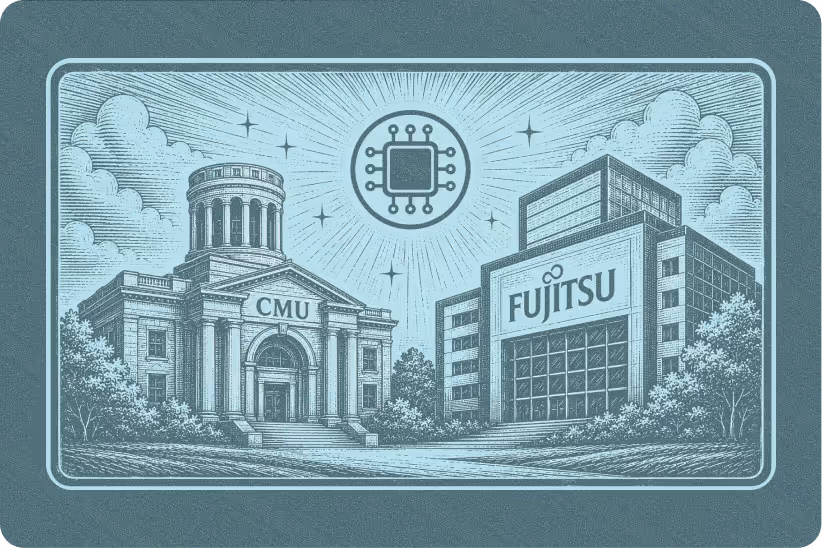
Artificial intelligence is moving beyond servers and screens. Carnegie Mellon University (CMU) and Fujitsu, a top Japanese IT provider, have partnered on an AI research center to revolutionize how machines interact with the physical world.
The Fujitsu-Carnegie Mellon Physical AI Research Center is devoted to creating AI-powered machines and robots that tackle critical issues like labor shortages and workplace safety. This groundbreaking partnership is a major leap toward bringing innovative physical AI solutions to real-world challenges.
This partnership demonstrates how embedding intelligence into real-world machines—and working together—drives true innovation across industries.
Bringing AI into the Physical World
Physical AI puts intelligence directly into robots and autonomous systems, allowing them to act, interact, and make decisions in the real world instead of just processing data behind screens.
With physical AI, machines can sense, decide, and act in real environments—handling obstacles and delicate tasks while making decisions on the spot. They move beyond computation to direct participation in the world.
Interest in physical AI is rapidly growing as experts turn to robotics and machine learning for practical solutions. The Fujitsu-CMU Center is the hub where these ideas become real-world innovations.
A State-of-the-Art Testing Ground
The research center is based at CMU’s advanced Robotics Innovation Center in Pittsburgh, offering top facilities for developing and testing physical AI systems.
The 150,000-square-foot facility equips researchers to rigorously develop and test physical AI systems, ensuring these machines are safe, reliable, and ready for real-world impact.
Solving the Global Labor Crisis
Global labor shortages are putting pressure on industries everywhere. Physical AI offers a real solution by enabling robots to handle repetitive or dangerous tasks, increasing productivity and safety while allowing people to focus on higher-value work.
Physical AI enables companies to boost productivity by deploying robots for repetitive or hazardous tasks, improving efficiency and workplace safety.
Physical AI empowers workers by handling tough, repetitive tasks. This lets people focus on safer, strategic roles and boosts overall efficiency.
Transforming Manufacturing and Logistics
Physical AI boosts manufacturing and logistics by helping robots quickly handle complex tasks like navigating warehouses, assembling parts, and managing inventory. This leads to faster, more reliable deliveries and efficient operations.
Unlike traditional robots, AI-powered machines quickly adapt to unexpected obstacles and changing environments.
These smart systems streamline tasks like loading, assembly, and inventory, making supply chains faster and more reliable.
Advancing Construction, Infrastructure, and Healthcare
Physical AI is revolutionizing construction, infrastructure, and healthcare by empowering robots to handle complex tasks, enhance safety, and support staff in critical roles.
In construction and infrastructure, robots handle heavy lifting, precise tasks, and structural inspections, improving safety and speeding up projects while preventing failures.
Physical AI also addresses healthcare staffing shortages by helping with patient transport, room cleaning, and supply management, allowing medical professionals to focus more on patient care.
The Power of Academic and Industry Partnerships
The Fujitsu-Carnegie Mellon Physical AI Research Center proves that major breakthroughs happen through strong academic and industry partnerships—achieving what neither could do alone.
Fujitsu brings deep IT expertise, while CMU leads in robotics, engineering, and AI research.
By combining CMU’s research innovation with Fujitsu’s industry know-how, this partnership rapidly turns groundbreaking AI and robotics ideas into real-world solutions that deliver real value.
Breaking Down Disciplinary Silos
Effective physical AI requires cross-disciplinary teamwork, combining expertise in engineering, robotics, language technologies, and ethics to tackle complex challenges.
Center experts in robotics, engineering, language technology, and ethics collaborate closely to ensure every physical AI system is advanced, safe, and reliable.
Why Collaboration and Standardization Matter
Physical AI still faces hurdles, like supply chain gaps and lack of standardization that keep robots and systems disconnected.
Without common standards and collaboration, physical AI systems stay isolated and can't scale across industries. The Fujitsu-CMU partnership is crucial for connecting these systems and enabling widespread adoption.
The Fujitsu-CMU partnership is driving physical AI forward by establishing standards and encouraging collaboration, making it easier for businesses to adopt and integrate smart machines across industries.
Building on a Legacy of AI Innovation
CMU advances AI by partnering with industry leaders to drive innovative research and real-world impact.
CMU’s recent collaboration with Bank of New York Mellon created a major AI Lab, while the university’s Learnvia platform now supports AI-driven learning at colleges nationwide.
Martial Hebert, dean of CMU’s School of Computer Science, says the new center strengthens CMU’s commitment to solving real-world problems through industry partnerships, ensuring innovations reach those who need them most.
Partner with FirstIgnite to Build the Future
The Fujitsu-Carnegie Mellon Physical AI Research Center proves that real progress comes from strong partnerships between industry and leading universities.
Partnering with leading institutions unlocks innovative AI and robotics solutions for your toughest business challenges.
Let FirstIgnite connect you with top academic partners to drive innovation and strategic growth.
Contact FirstIgnite to explore partnerships and accelerate innovation for your business.

.avif)
No items found.
September 30, 2022
•
xx
MIN READ
The Soft and Hybrid Nanotechnology Experimental Resource, or SHyNE, is a collaboration between the University of Chicago and Northwestern University which provides access to state-of-the art research facilities and technical expertise in nanoscale characterization and fabrication. SHyNE serves scientists and engineers from industry, academia, government and non-profit sectors as part of the NSF National Nanotechnology Coordinated Infrastructure (NNCI) program. Seeking increased industry collaborations for the resource’s seven major facilities, Northwestern University partnered with FirstIgnite to run targeted marketing campaigns throughout the summer of 2022.Research facility staff often do not have the time to create targeted outbound marketing campaigns and maintain communication with interested organizations. FirstIgnite’s marketing campaign services take any corporate engagement initiative and quickly identify and target companies and decision making contacts to schedule one to one conversations with. By scheduling and coordinating initial Zoom meetings between research facility staff and companies, FirstIgnite removes the tedious leg work that’s needed to start real, valuable partnerships.The marketing campaign for SHyNE was the third campaign the Northwestern team requested support for from FirstIgnite, following successful campaigns for sponsored research and IUCRC initiatives. Seeing past success in connecting with varied companies like Xylem and Zimmer Biomet, their team needed to find new partners to take advantage of the facilities within SHyNE as well as potentially collaborate on future corporate initiatives together.[caption id="attachment_4501" align="alignnone" width="1873"]

The SHyNE Resource website.[/caption]SHyNE staff were able to connect with 15+ companies within a month of using FirstIgnite’s marketing services, with 60% of those conversations potentially leading to seed grants. Directors of Product Engineering, Senior Principal Product Engineers, and Chief Technology Officers were just a few of the title types that raised their hands to learn more about SHyNE’s facilities.FirstIgnite’s marketing services are a multifaceted experience which can take any industry engagement initiative occurring at a university or research institute and ensure that active connections are made. In fact, throughout September 2022, 250 of these connections did occur on behalf of FirstIgnite’s partners. SHyNE’s experience is just one of many examples of the success found in sustained marketing efforts with FirstIgnite.
No items found.
Johns Hopkins Applied Physics Laboratory Creates 20+ New Industry Connections Through FirstIgnite’s Partnership Development Service in the first 30 days
September 15, 2022
•
xx
MIN READ
Johns Hopkins Applied Physics Laboratory (APL) is responsible for solving complex research, engineering, and analytical problems that present critical challenges to the United States of America. APL—the nation’s largest university affiliated research center—provides U.S. government agencies with deep expertise in specialized fields to support national priorities and technology development programs. In order to continue to proliferate their research, APL’s Technology Transfer Office has been utilizing FirstIgnite’s Partnership Development Service (PDS) services in 2022 to maximize the number of corporate engagement conversations they are able to have for their technology portfolio month over month.For technology transfer teams, the process of prospecting and communicating with contacts can be tedious, time consuming, and disorganized. FirstIgnite’s PDS services allow research institutions and universities to quickly amass meetings with companies interested in their corporate engagement initiatives. Utilizing proprietary software, FirstIgnite can swiftly identify potential partnership businesses and contacts and communicate with them through targeted email marketing campaigns and LinkedIn contact.APL was drawn to PDS for a variety of reasons following an initial demo of the service, which included a single marketing campaign that put them in touch with companies like Ball Aerospace, Siemens, and Fortinet for a virtual programmable logic controller technology. Seeing this first success, their team signed up for PDS to market multiple technologies at once, vastly increasing the number of conversations they were having per technology, all while taking away the tedious prospecting work that comprises the bulk of initial outreach to companies and other interested organizations.[caption id="attachment_4509" align="alignnone" width="1224"]

Johns Hopkins Applied Physics Laboratory Website.[/caption]Three licensing team members were able to create 20+ new industry connections by utilizing PDS for their technology portfolio in the first month alone. FirstIgnite was able to coordinate meetings with Vice Presidents of Engineering, Science and Technology Directors, Heads of Research and Development, and more; decision making titles that have the authority to continue those discussions onward to licensing deals.These results from FirstIgnite aren’t rare. Across the month of September 2022, FirstIgnite was able to coordinate upwards of 250 conversations between its university partners and businesses. By taking advantage of FirstIgnite’s PDS, APL was able to see this same kind of success from their consistently marketed technology portfolio.Connecting Industry & Academia
No items found.
FirstIgnite Feature Release: New Campaign Data Dashboard Makes Tracking Campaign Activity Easier Than Ever
August 31, 2022
•
xx
MIN READ
We're excited to announce our newest feature to the FirstIgnite platform: a campaign data dashboard that consolidates all of your most relevant campaign statistics in one place. You can now receive real-time access to all marketing and meeting activity happening within your campaign. This includes email activity, the companies and leads contacted on your behalf, and various marketing page view statistics.With this campaign data dashboard, we are able to provide you with a visually appealing way to view and interact with important campaign information, whether it be for feedback purposes, to display at your internal meetings, or generally just to keep you updated. This new dashboard is your FirstIgnite data hub.Connecting Industry and Academia
No items found.
Michigan State University Teams Up with FirstIgnite to Support their Recoverable Liquid Nanofoam Energy Absorbers Technology.
August 26, 2022
•
xx
MIN READ
FirstIgnite and Michigan State University partnered together this Summer to increase corporate engagement support for the lead inventor, Dr. Weiyi Lu, and to further develop the understanding of a novel energy absorption system consisting of a non-hazardous liquid, proprietary nanoporous particles, and selected levels of additional gas.Organizations like Beyond Gravity, Gentex, Avon Protection, and many more engaged with staff from Michigan State University to learn more about how this technology, coined “liquid nanofoam” by MSU researchers, which offers high energy absorption at low thickness to weight ratios.FirstIgnite supports technology transfer offices across the United States, UK, and Canada, helping to foster growth with industry partners.Connecting Industry and Academia
No items found.
FirstIgnite Success Story: Drexel University Partners with FirstIgnite for their Anti-Aging Topical Treatment Technology
August 15, 2022
•
xx
MIN READ
This summer FirstIgnite and Drexel University partnered together to increase engagement for Drexel affiliated startup, Boinca Therapeutics, by reaching out to hundreds of companies that would be interested in strategic partnerships for this preclinical company to advance the technology through the FDA process and commercialize it for aesthetic and/or therapeutic markets.Organizations like DermBiont, Sensus Healthcare, DermTech, and many more engaged with staff from Drexel University and Boinca Therapeutics to learn more about this topical cream, and how when used daily during a 6-month study, showed an increase in collagen and lower levels of key biomarkers of aging skin.FirstIgnite supports university affiliated startups across the United States, UK, and Canada, helping to foster growth with industry partners interested in acquiring and licensing companies and technologies.Connecting Industry and Academia
No items found.
University of Notre Dame's IDEA Center and FirstIgnite Partner Together
August 10, 2022
•
xx
MIN READ
FirstIgnite and the University of Notre Dame's IDEA Center have commenced work together on increasing corporate engagement for a portfolio of technologies throughout 2022 and into 2023.“Steady, continuous marketing of technologies is absolutely the way to maximize our partner's relationship with our team as well as create a drastic increase in value regarding the total number of company introductions made,” says David Melie, Head of Partnerships at FirstIgnite. “Notre Dame understands this precisely and we're excited to grow their corporate network throughout the upcoming year.”This is the first partnership between FirstIgnite and the University of Notre Dame. FirstIgnite supports commercialization and corporate engagement offices at universities across the United States, UK, and Canada.Connecting Industry and Academia
No items found.
FirstIgnite Sponsors NACRO Conference: July 19th - July 21st
July 27, 2022
•
xx
MIN READ
FirstIgnite has returned full of energy after sponsoring the 2022 NACRO Annual Conference in Minneapolis from July 19th to the 21st. Over 171 universities attended, focused on networking and professional development of corporate relations.The excitement of being back in person, seeing familiar faces, and building new connections was a fantastic experience. We were taken aback by the inclusiveness of this group.Three interesting themes from the conference included:
- Diversity, Equity and Inclusion - This is a primary focus for most universities and it’s very exciting to see it be a focal point for corporate relations officers.
- Holistic Corporate Relations - How does a campus help corporate partners engage with the wide variety of partnership opportunities on campus?
- Tracking and Reporting - What CRM should an office be using? How do we use data to tell a story or to identify opportunities?
One other area that we found a lot of interest around was developing an outbound marketing strategy for corporate partnerships. Many universities are reactive, rather than proactive, in reaching out and connecting with new corporate partners. FirstIgnite can help in this area. The FirstIgnite team got to meet many of our partners in person for the first time and connected with new partners as well. We look forward to reconnecting with each of you online now that the conference is over. Most importantly, we look forward to seeing you in person at the next NACRO conference in Portland, Oregon in 2023!Connecting Industry and Academia
No items found.
Northwestern University Turns to FirstIgnite for Increased Corporate Engagement Support
July 25, 2022
•
xx
MIN READ
Northwestern University, seeking to grow their pipeline of corporate engagement partnerships, has teamed up with FirstIgnite to support sponsored research and Industry-University Cooperative Research Center (IUCRC) growth opportunities.“Northwestern University is a premier name associated with world-class innovations and research,” says David Melie, Head of Partnerships at FirstIgnite. “To put that research into the hands of interested companies who can help bring these innovations to market is a win-win not just for industry and academia relations, but for humanity as a whole.”Northwestern University has worked in the past with FirstIgnite to engage companies interested in their human/robot collaboration technology portfolio. Their team is currently seeking corporate engagement for their work in photovoltaics and for their Artificial Intelligence Enabled Water Energy Nexus IUCRC.Connecting Industry and Academia
No items found.
How can a Research Organization act like a Sales Organization?
July 23, 2022
•
xx
MIN READ
Research organizations and universities are unique in terms of their product and focus. They are at the forefront of innovation, often playing a role in inventing the solutions necessary for new products to enter the market. Historically, these organizations have relied on inbound interest from external partners to grow their business.As universities and research organizations think about the future, they are beginning to include outbound sales and marketing into their strategic plans. In order to achieve audacious goals like growing corporate sponsored research by $60M over 5 years, it’s important that these organizations begin to think and act like a sales organization.The first step to operating like a “sales organization ” instead of a “research organization” is to implement a sales development strategy.What is sales development? Sales development is a method that helps tech companies scale from $0 in revenue to $100M or more in revenue. To achieve this level of growth, organizations must build a sales machine that creates ongoing and predictable revenue.Universities have a product that can scale revenue growth across patents, core facilities, and sponsored research, but to achieve continued revenue growth we must implement three key steps:
- Predictable Lead Generation: The most important item. Constant new leads for all of your areas of excellence.
- A Sales Development Team: This group uses leads to run cold outreach and book appointments for the “sales team”.
- Sales Professionals: Known as licensing managers and corporate relations officers at universities. These team members nurture relationships and close deals.
We’ve found that the most immediate impact on a university’s predictable revenue is creating an outbound sales development team (basically junior salespeople). This team focuses 100% on prospecting new leads and managing the cold outreach via email, phone, and LinkedIn to book appointments for managers.FirstIgnite assumes this role in the prospecting and cold outreach on behalf of research universities. We market research and book appointments for corporate relations officers to meet with companies interested in partnering.When corporate relations and licensing managers no longer have to focus on prospecting and cold outreach, they can focus 100% of their efforts on building relationships and moving warm leads down the pipeline to a fruitful relationships.FirstIgnite helps universities across the globe book more appointments with industry than ever before. Customers such as Stanford’s AI Laboratory, Johns Hopkins APL Tech Transfer office, and many others are working with FirstIgnite and implementing these strategies every day.It might sound crazy, but a certain peace of mind comes with knowing your organization will be generating new leads and booking appointments with industry without your constant focus and attention.Connecting Industry and Academia
No items found.
Stanford University Teams Up with FirstIgnite for their Future of Digital Currency Initiative
July 20, 2022
•
xx
MIN READ
FirstIgnite and Stanford University have partnered together to increase business engagement for Stanford’s Corporate Affiliate Program and their Future of Digital Currency Initiative. By reaching out to hundreds of digital currency companies, FirstIgnite was able to find well suited candidates able to aide in the understanding of the emerging role of digital currencies in promoting global financial inclusion, and their role in the evolution and growth of digital economies.Organizations like Circle.com, Bitstamp, utrust, and many more engaged with the Stanford team to learn more about how technologists and policymakers create interoperability between digital currencies, blockchains, and existing financial infrastructures.FirstIgnite supports NSF funded organizations and research facilities across the United States, helping to foster growth with industry partners.Connecting Industry and Academia
No items found.
University of Massachusetts Amherst Partners with FirstIgnite on New Flame Retardant Technology
July 18, 2022
•
xx
MIN READ
FirstIgnite and University of Massachusetts Amherst (UMass) partnered together throughout June and July to increase corporate engagement support for the lead inventor, Todd Emrick, of their reduced polymer flammability technology by creating strong partnerships and collaborations.Organizations like Dow Chemical, Asbury Carbons, Kisuma Chemicals, and many more engaged with the UMass technology transfer team to learn about their work in incorporating monomers into polymer structures.FirstIgnite supports technology transfer teams across the United States, helping to foster growth with industry partners.Connecting Industry and Academia
No items found.
FirstIgnite Success Story: Stony Brook University Technology Transfer Marketing Campaign
July 1, 2022
•
xx
MIN READ
Campaign Objective:FirstIgnite and Stony Brook University (SBU) partnered together this past Spring to increase corporate engagement support for Dr. Anthony Lubinsky and his team’s portfolio of technologies regarding dual-screen digital radiography.Campaign Methodology:FirstIgnite combined multiple technologies into a single marketing campaign in order to better communicate with potential licensing partners the full scope of SBU’s digital radiography portfolio. This approach increased the reach by expanding the net of total potential companies interested in meeting with the university. Next, FirstIgnite leveraged patents and publications associated with the portfolio in order to identify as many companies and contacts as possible.With this large net of potential licensees identified, FirstIgnite conducted a 30 day marketing campaign, reaching out via email and LinkedIn to over 200 people at 80 companies.Campaign Outcome: FirstIgnite was able to connect the Stony Brook team with organizations around the world, including Anritsu, Esaote, Philips and more. These teams, interested in potential licensing opportunities with Stony Brook, now have a direct one to one feed with SBU staff moving forward into the future and for new collaborations.Partner Quote: "FirstIgnite's efforts were effective in bringing together technologists from the university with counterparts at companies with the resources to develop and commercialize mutually interesting inventions." - Dr. Anthony LubinskyConnecting Industry and Academia