


RESOURCES
Blogs
Insights, strategies, and updates on research commercialization, university innovation, industry partnerships, and AI-powered prospecting
Connecting Industry & Academia
CMU and Fujitsu Launch Physical AI Research Center
April 27, 2026
•
xx
MIN READ
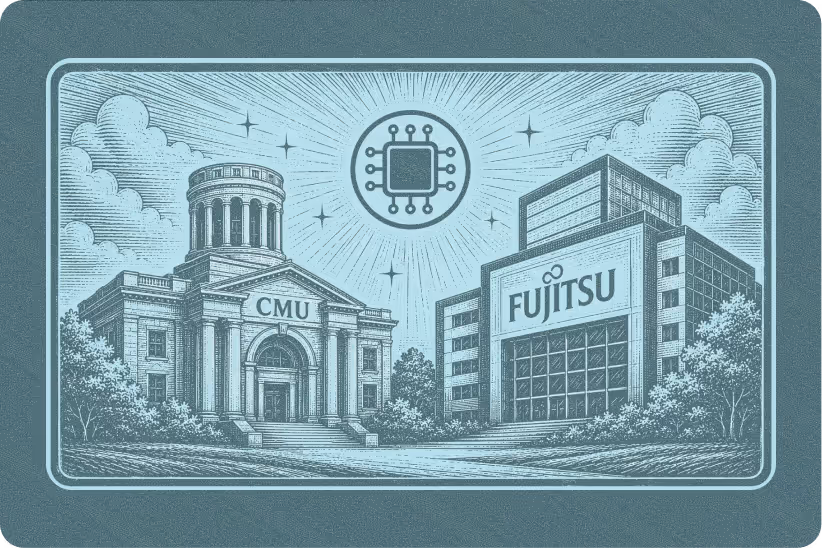
Artificial intelligence is moving beyond servers and screens. Carnegie Mellon University (CMU) and Fujitsu, a top Japanese IT provider, have partnered on an AI research center to revolutionize how machines interact with the physical world.
The Fujitsu-Carnegie Mellon Physical AI Research Center is devoted to creating AI-powered machines and robots that tackle critical issues like labor shortages and workplace safety. This groundbreaking partnership is a major leap toward bringing innovative physical AI solutions to real-world challenges.
This partnership demonstrates how embedding intelligence into real-world machines—and working together—drives true innovation across industries.
Bringing AI into the Physical World
Physical AI puts intelligence directly into robots and autonomous systems, allowing them to act, interact, and make decisions in the real world instead of just processing data behind screens.
With physical AI, machines can sense, decide, and act in real environments—handling obstacles and delicate tasks while making decisions on the spot. They move beyond computation to direct participation in the world.
Interest in physical AI is rapidly growing as experts turn to robotics and machine learning for practical solutions. The Fujitsu-CMU Center is the hub where these ideas become real-world innovations.
A State-of-the-Art Testing Ground
The research center is based at CMU’s advanced Robotics Innovation Center in Pittsburgh, offering top facilities for developing and testing physical AI systems.
The 150,000-square-foot facility equips researchers to rigorously develop and test physical AI systems, ensuring these machines are safe, reliable, and ready for real-world impact.
Solving the Global Labor Crisis
Global labor shortages are putting pressure on industries everywhere. Physical AI offers a real solution by enabling robots to handle repetitive or dangerous tasks, increasing productivity and safety while allowing people to focus on higher-value work.
Physical AI enables companies to boost productivity by deploying robots for repetitive or hazardous tasks, improving efficiency and workplace safety.
Physical AI empowers workers by handling tough, repetitive tasks. This lets people focus on safer, strategic roles and boosts overall efficiency.
Transforming Manufacturing and Logistics
Physical AI boosts manufacturing and logistics by helping robots quickly handle complex tasks like navigating warehouses, assembling parts, and managing inventory. This leads to faster, more reliable deliveries and efficient operations.
Unlike traditional robots, AI-powered machines quickly adapt to unexpected obstacles and changing environments.
These smart systems streamline tasks like loading, assembly, and inventory, making supply chains faster and more reliable.
Advancing Construction, Infrastructure, and Healthcare
Physical AI is revolutionizing construction, infrastructure, and healthcare by empowering robots to handle complex tasks, enhance safety, and support staff in critical roles.
In construction and infrastructure, robots handle heavy lifting, precise tasks, and structural inspections, improving safety and speeding up projects while preventing failures.
Physical AI also addresses healthcare staffing shortages by helping with patient transport, room cleaning, and supply management, allowing medical professionals to focus more on patient care.
The Power of Academic and Industry Partnerships
The Fujitsu-Carnegie Mellon Physical AI Research Center proves that major breakthroughs happen through strong academic and industry partnerships—achieving what neither could do alone.
Fujitsu brings deep IT expertise, while CMU leads in robotics, engineering, and AI research.
By combining CMU’s research innovation with Fujitsu’s industry know-how, this partnership rapidly turns groundbreaking AI and robotics ideas into real-world solutions that deliver real value.
Breaking Down Disciplinary Silos
Effective physical AI requires cross-disciplinary teamwork, combining expertise in engineering, robotics, language technologies, and ethics to tackle complex challenges.
Center experts in robotics, engineering, language technology, and ethics collaborate closely to ensure every physical AI system is advanced, safe, and reliable.
Why Collaboration and Standardization Matter
Physical AI still faces hurdles, like supply chain gaps and lack of standardization that keep robots and systems disconnected.
Without common standards and collaboration, physical AI systems stay isolated and can't scale across industries. The Fujitsu-CMU partnership is crucial for connecting these systems and enabling widespread adoption.
The Fujitsu-CMU partnership is driving physical AI forward by establishing standards and encouraging collaboration, making it easier for businesses to adopt and integrate smart machines across industries.
Building on a Legacy of AI Innovation
CMU advances AI by partnering with industry leaders to drive innovative research and real-world impact.
CMU’s recent collaboration with Bank of New York Mellon created a major AI Lab, while the university’s Learnvia platform now supports AI-driven learning at colleges nationwide.
Martial Hebert, dean of CMU’s School of Computer Science, says the new center strengthens CMU’s commitment to solving real-world problems through industry partnerships, ensuring innovations reach those who need them most.
Partner with FirstIgnite to Build the Future
The Fujitsu-Carnegie Mellon Physical AI Research Center proves that real progress comes from strong partnerships between industry and leading universities.
Partnering with leading institutions unlocks innovative AI and robotics solutions for your toughest business challenges.
Let FirstIgnite connect you with top academic partners to drive innovation and strategic growth.
Contact FirstIgnite to explore partnerships and accelerate innovation for your business.

.avif)
No items found.
July 1, 2022
•
xx
MIN READ
FirstIgnite and the University of Oregon (UO) partnered together this past Spring to increase corporate engagement support for UO’s Industry-University Cooperative Research Center (IUCRC), the Center for Big Learning.Organizations like Graphcore, DataRobot, Owkin, and many more engaged with center staff to learn about their work intersecting deep learning, big systems, and big data.“The lifeblood of every IUCRC center is a robust network of affiliate organizations interested in partnering on their research,” says David Melie, Head of Partnerships at FirstIgnite. “To help expand that network and create new potential collaborations is a point of pride for our team.”FirstIgnite supports NSF funded organizations and research facilities across the United States, helping to foster growth with industry partners.Connecting Industry and Academia
No items found.
FirstIgnite Supporting Johns Hopkins Applied Physics Laboratory
June 28, 2022
•
xx
MIN READ
FirstIgnite and Johns Hopkins Applied Physics Laboratory (APL) have teamed up to increase corporate engage for their technology portfolio including their work in virtual programmable logic controllers (vPLCs)."The Applied Physics Lab is one of the top research institutions in the world and we're grateful for the opportunity to support translating their research into impactful action. APL conducts complex research, across engineering and analytical problems," says Chase Bonhag, FirstIgnite CEO. “We’re proud to partner with an organization solving critical challenges for our nation.”The APL is the first partnership between FirstIgnite and Johns Hopkins. FirstIgnite supports corporate engagement for research facilities across the globe, interested in increasing their technologies reach and influence.Connecting Industry and Academia
No items found.
FirstIgnite Increasing Corporate Engagement for Research at the Idaho National Laboratory (INL)
April 19, 2022
•
xx
MIN READ
FirstIgnite and the Idaho National Laboratory (INL) are partnering to help increase corporate engagement for INL’s research portfolio, including their work in high powered wireless charging.“The work occurring at INL is world class and world changing,” says FirstIgnite CEO, Chase Bonhag. “We’re proud to be supporting an organization inventing technologies that will make the world a greener, more efficient place.”INL is entering their second engagement with FirstIgnite, having found success with their team for a variety of research engagement needs in 2021. FirstIgnite supports corporate engagement for research facilities across the globe, expanding their international reach.Connecting Industry and Academia
No items found.
Connecting Industry & Academia: University of California Davis
April 18, 2022
•
xx
MIN READ
Welcome to our second blog post in our series Connecting Industry & Academia. Any questions or comments? Please reach out through our Contact Us page here.Campaign Objective: The University of California, Davis had a growing number of technologies in their portfolio, with more being added every month, and needed marketing support. With a growing portfolio, they realized partnering with FirstIgnite to set up a consistent technology marketing program would generate new business opportunities throughout the yearApproach: FirstIgnite worked with the university in order to create a plan that worked. This meant taking into account multiple stakeholders, including faculty members, licensing managers and directors. Together, FirstIgnite came up with a strategy to systematically work through the IP portfolio by conducting two marketing campaigns per month. The campaigns would rotate to ensure no licensing manager was overburdened and that the entirety of the portfolio would be supported. With a plan in place, FirstIgnite began prospecting companies and contacts for new technologies every month, executing marketing campaigns, and preparing for the next campaigns. FirstIgnite became an integral part of their team.Result: Consistent marketing efforts led to compounding results. During the next year, UC Davis would meet with over 50 new industry partners, leading to tens of CDA agreements and many relationships moving down the path to licensing. The consistency of outbound, active marketing has played a significant role in driving industry activity across the IP portfolio. The results also led to FirstIgnite supporting additional groups at UC Davis as well as other campuses in the University of California system. Some examples of companies that UC Davis met with through FirstIgnite include: BASF, Cabot, Endo Pharmaceutical, Armacell, Nrgene, Elo Life Systems, S&W Seeds, QuickLogic, Microsoft, and many more.Faculty Quote: “FirstIgnite constantly delivered new industry meetings for technologies across our portfolio, ranging from agriculture, to blood monitoring, to new therapeutics.” - Director of Business Development & Licensing
No items found.
Connecting Industry & Academia: Oklahoma State University
April 7, 2022
•
xx
MIN READ
Welcome to our first blog post in our series Connecting Industry & Academia. Any questions or comments? Please reach out through our Contact Us page here.Campaign Objective:The College of Engineering at Oklahoma State University had recently hired 50 new faculty members. In order to prepare for the future, the college wanted to invest in developing relationships between the newly hired junior faculty and industry partners. FirstIgnite partnered with Oklahoma State University to run targeted marketing campaigns on behalf of the new facultyApproach:First, FirstIgnite selected two faculty members and identified their areas of interest and research history. By leveraging previous publications and areas of interest, FirstIgnite was able to prospect potential companies that would be a good fit. In total, FirstIgnite identified 150 companies to reach out to. Next, FirstIgnite identified contacts at those companies across strategy, innovation, and R&D. With a wide net of potential companies and contacts, FirstIgnite began a series of outbound email marketing campaigns as well as a follow up on LinkedIn to each contact. In total, FirstIgnite approached over 300 professionals.Result:Within 30 days, Oklahoma State University had a busy calendar full of meetings with industry. In total, 15 companies showed interest in meeting with the university and learning more about potential partnership and collaboration opportunities. These meetings are with leadership at companies with the ability to directly fund research on campus. The most important outcome is that the new faculty members now have a rolodex of companies who they are engaged with moving forward. The fastest path to a sponsored research project is a pre-existing relationship the faculty member has. Now, the new faculty members at Oklahoma State University have a strong industry network.Faculty Quote:“FirstIgnite delivers. In the first 30 days of working with FirstIgnite, they brought over 15 companies to our team who were interested in engaging with our faculty.” - Associate Dean of Research
No items found.
The University of Louisville Partners with FirstIgnite for Facility Support
March 20, 2022
•
xx
MIN READ
The University of Louisville has turned to FirstIgnite to support corporate engagement for their Micro/Nano Technology Center (MNTC).“The MNTC is a world class facility with capabilities in photolithography, thin film deposition and much more,” says Chase Bonhag, FirstIgnite CEO. “Companies interested in speaking with the Louisville team will be excited at the process potential that the MNTC can provide to their team.”The University of Louisville has partnered with FirstIgnite in the past for corporate engagement for two other on campus facilities; the Additive Manufacturing Institute of Science and Technology (AMIST) and the Logistics and Distribution Institute (LODI).Connecting Industry and Academia
No items found.
FirstIgnite Partners with Drexel University to Support Product Portfolio
March 17, 2022
•
xx
MIN READ
FirstIgnite is excited to announce our newest partnership with Drexel University to support a variety of technologies available for licensing.“Beginning with technologies in the fields of bio-rubber and isosorbides, we will have an opportunity to find corporate partners interested in bringing this research to the consumer marketplace,” says Chase Bonhag, FirstIgnite CEO.Drexel University has worked with FirstIgnite in the past to support corporate engagement within its research portfolio.Connecting Industry and Academiawww.FirstIgnite.com
No items found.
Carnegie Mellon University Partnering with FirstIgnite
March 10, 2022
•
xx
MIN READ
FirstIgnite is proud to announce our newest partnership with Carnegie Mellon University. FirstIgnite is seeking companies interested in partnering on experiential learning opportunities at the intersection of AI, bioinformatics, and medical devices to partner with the biomedical engineering department within the College of Engineering at the university.“Biomedical students at Carnegie Mellon University have been taught by world class faculty,” says Chase Bonhag, FirstIgnite CEO. “Now, thanks to our new partnership with CMU, these students will be able to put what they’ve learned into actionable situations which will help them build real world experience.”This is the newest collaboration between Carnegie Mellon University and FirstIgnite, who have partnered in the past to increase corporate engagement for CMU research in the College of Engineering and the Mellon College of Sciences.Connecting Industry and Academia
No items found.
FirstIgnite Attending 2022 SXSW Festival in Coordination with Midwest House
March 7, 2022
•
xx
MIN READ
FirstIgnite is excited to take part in the 2022 SXSW conference from March 11th to the 13th in collaboration with Midwest House.“We’re looking forward to exploring new forms of collaboration with companies throughout the Midwest and around the world,” says David Melie, FirstIgnite’s Director of Partnerships. “SXSW has grown into something much more than just an arts and music festival and we’re excited to join the other entrepreneurs at the Midwest House to see what makes Austin weird!”SXSW will be an in-person conference for the first time since 2019 due to the COVID-19 pandemic. FirstIgnite thanks the Midwest House for helping to support their attendance at this year’s conference.
No items found.
Preparing for Your Upcoming Meeting with Industry
March 1, 2022
•
xx
MIN READ
When meeting with companies and corporations, your ability to know them greater than they know themselves is key to having a successful conversation which can lead to meaningful support for your university’s research. Companies need to know quickly how your research will help effect their bottom line, and by coming into the discussion with solid information and understanding of their wants and needs, you’ll know how your team’s research will help keep them in the black.A few points to prepare successfully:Take a look at their website- This one may seem simple, but ignoring a company’s most forward-facing marketing tool does happen, and to the detriment of all involved. All the most basic information on the company’s values and goals can be found on their website, and a well-informed team will be able to get into specific details on content found online that may be directly relevant to your team’s research.Search for recent news articles- Stay up to date! A company’s news section is typically found on their website but a quick search on Google or any other platform will help to ensure that you know the goings on of a company as most up to date as possible. You’ll also be able to get an understanding on other relevant stories happening in the company’s industry. Nothing derails a conversation faster than a mention of negative news or obsolete information.Find comparable products to your research- It doesn’t matter if a company is B2C (business to consumer) or B2B (business to business), you should always understand what they are selling. Getting an understanding of their product portfolio will allow you to form real world comparables between your research and how it can quickly and effectively be incorporated into their business.Understand the roles of everyone who will be on the call, including on your own team- Taking the time to look up all attendees on LinkedIn is a fast and easy way to get a snapshot into their responsibilities at the company before the conversation even begins. Knowing a team member’s role will allow you to quickly assess where seniority resides, and also who the decision maker will be. At the same time, before the conversation begins, make sure you know who will be leading the conversation from your end as well. Speaking over one another leads to confusion, lost time, and at worst, bruised egos.Prepare for the little things to cause big trouble- Small holes sink big ships, and if you don’t prepare for all contingencies, you may find yourself in a tough spot. For example, if you’re doing a Zoom call, be prepared with another teleconferencing service in reserve, or a phone line that all team members can dial into if the internet goes down. If you’re meeting in person, create a schedule the night before to plan for any issues that may come up and slow you down in making it to the discussion.Successfully prepared teams are better able to overcome objections that can end relationships promptly. For some companies, success comes moment to moment, and being prepared to be a part of that success will make ensure you make your moment count.
No items found.
FirstIgnite Partners with William & Mary's Global Research Institute
February 22, 2022
•
xx
MIN READ
FirstIgnite is proud to announce our newest partnership with the College of William & Mary in Williamsburg, Virginia, to help support and disseminate research being developed within their Global Research Institute (GRI).“Students and faculty at the GRI are working on applied research for projects that have worldwide implications for a positive impact,” says Chase Bonhag, FirstIgnite CEO. “We’re looking forward to being a major partner in making sure that research gets in the hands of organizations interested and ready to offer support.”William & Mary joins a long list of universities partnered with FirstIgnite who are seeking increased industry engagement for their research.Connecting Industry and Academia
No items found.
FirstIgnite Heading to #AUTM2022
February 18, 2022
•
xx
MIN READ
It’s finally here! FirstIgnite is heading south to attend the AUTM 2022 Annual Meeting in New Orleans. Along with hundreds of tech transfer professionals from around the world, our team is excited to introduce ourselves in person for the first time. We’ll be at Booth #700 and look forward to meeting you.
FirstIgnite Background
FirstIgnite is a venture-backed startup, with investors including Y-Combinator, Red Cedar Ventures, Advisors Fund, and was founded in January 2019. Our team supports universities in marketing their intellectual property, professors, and core facilities to industry. Our business model is simple; we run high-touch, active marketing campaigns on behalf of university research. Our marketing campaigns work; we average 5+ meetings with industry in the first 30 days of marketing a patent or professor.
Free Marketing Campaigns

Growth and impact for your universities research starts first and foremost with a consistent and valuable marketing approach. The key is consistent, active marketing across your portfolio to drive new industry relationships to licensing managers throughout the year. FirstIgnite will be offering a single free marketing campaign (a $5,000 value!) to all AUTM attendees (new customers) who stop by to speak with our CEO, Chase Bonhag, at Booth #700. You’re going to want to try one of these; for our 40 plus university partners last year, our marketing campaigns brought them over 600 conversations with different companies interested in collaborating on their research. Don’t miss out! Make sure to find time to speak with Chase and learn about this powerful service.
Learn About a New Way to Increase Corporate Engagement
Like Chase wrote in his blog on research revenue growth, active and consistent marketing efforts are key to being the leader in the tech transfer community. FirstIgnite uses its own proprietary software to make sure we connect your research with companies that are already highly vested in it, through patents, job listings, news articles, and more. Our marketing campaigns put you directly into the room with companies that can enact change with your research, all while ensuring you and your team have more time to close important steps in the licensing process.

It's been a long time coming, but we’re excited to finally introduce ourselves to you all this week. We’re looking forward to the beginning of many new partnerships at AUTM 2022, and they all begin with a quick stop to see us at Booth #700. See you there!